


How one wing part stopped a Boeing freighter line, and a plane reportedly meant for FedEx
A wing-parts supplier most people have never heard of stopped shipping, according to Boeing. For nearly two months, Boeing built no 777 Freighters, Reuters reported, citing Boeing workers. One of the unfinished planes pulled off the line was reportedly meant for FedEx.
FedEx did not buy those wing parts. It buys airplanes from Boeing. Seen from FedEx, the wing-parts maker was a Tier 2 supplier: the supplier of its supplier. This case shows how risk can travel from a company you have never heard of all the way to you. It also shows that public signs of trouble at this supplier appeared months before the production stop made headlines.
Key facts
- Supplier: Falcon Jacksonville, LLC, doing business as VAERO, in Jacksonville, Florida. The plant was formerly part of Kaman Aerospace.
- Part: trailing-edge rib kits for the wing. According to Boeing's lawsuit, Vaero was the sole supplier.
- Impact: 777 Freighter production stood still for nearly two months (Reuters, October 23, 2026). Output of the 767, including the KC-46 military tanker, was also disrupted.
- Cost: up to $6.5 million a day, according to Boeing's own estimate in its lawsuit.
- End customer: two partly built 777 Freighters were reportedly removed from final assembly. Reuters identified one as meant for FedEx, using data from the consultancy IBA.
- Early signals: a $31 million demand and a threat to stop deliveries to Boeing at this supplier were reported on February 3, 2026.
- Outlook: Boeing expects shortages from a key 777 supplier to disrupt production through the first half of 2027 (Form 10-Q, Q3 2026).
What are trailing-edge rib kits, and why could Boeing not build wings without them?
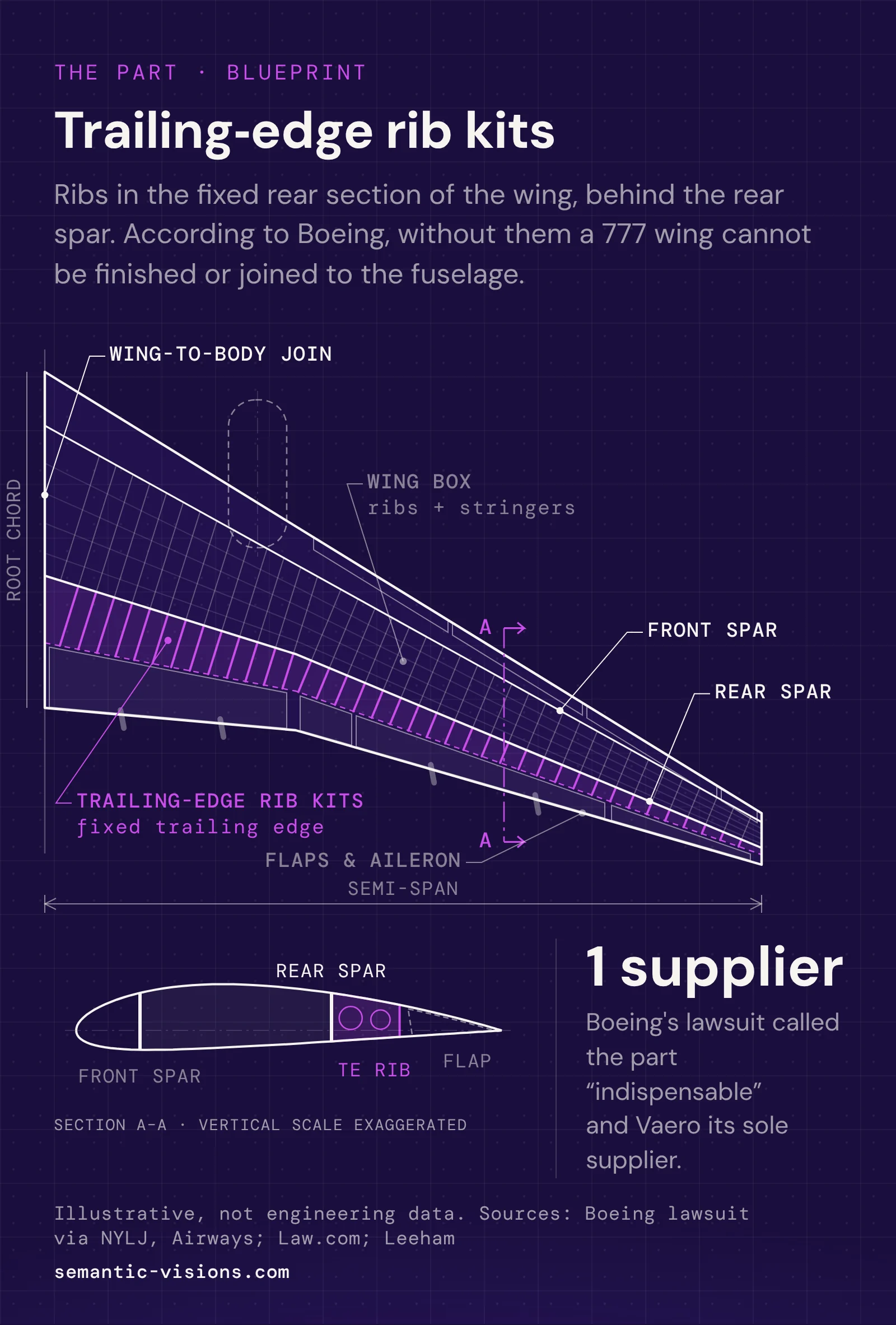
Trailing-edge rib kits are sets of ribs that shape the rear section of the wing and support its skin. According to Boeing's lawsuit, as reported by the New York Law Journal, Boeing could not finish the fixed trailing edge of a 777 wing, or join the wing to the fuselage, without them.
Boeing called the part "indispensable" and said Vaero was its sole supplier. A sole-source supplier is the only approved source of a part. When it stops delivering, there is no second supplier to switch to.
What happened between Boeing and Vaero?
In August 2026, Boeing sued Vaero, saying the supplier had stopped delivering the rib kits. The companies settled in late September, but by October 23 the 777 Freighter line had still not restarted, according to Reuters.
The $6.5 million figure is Boeing's estimate in a court filing, not a confirmed loss. On October 27, Boeing's CFO said the impact was not material to the third quarter.
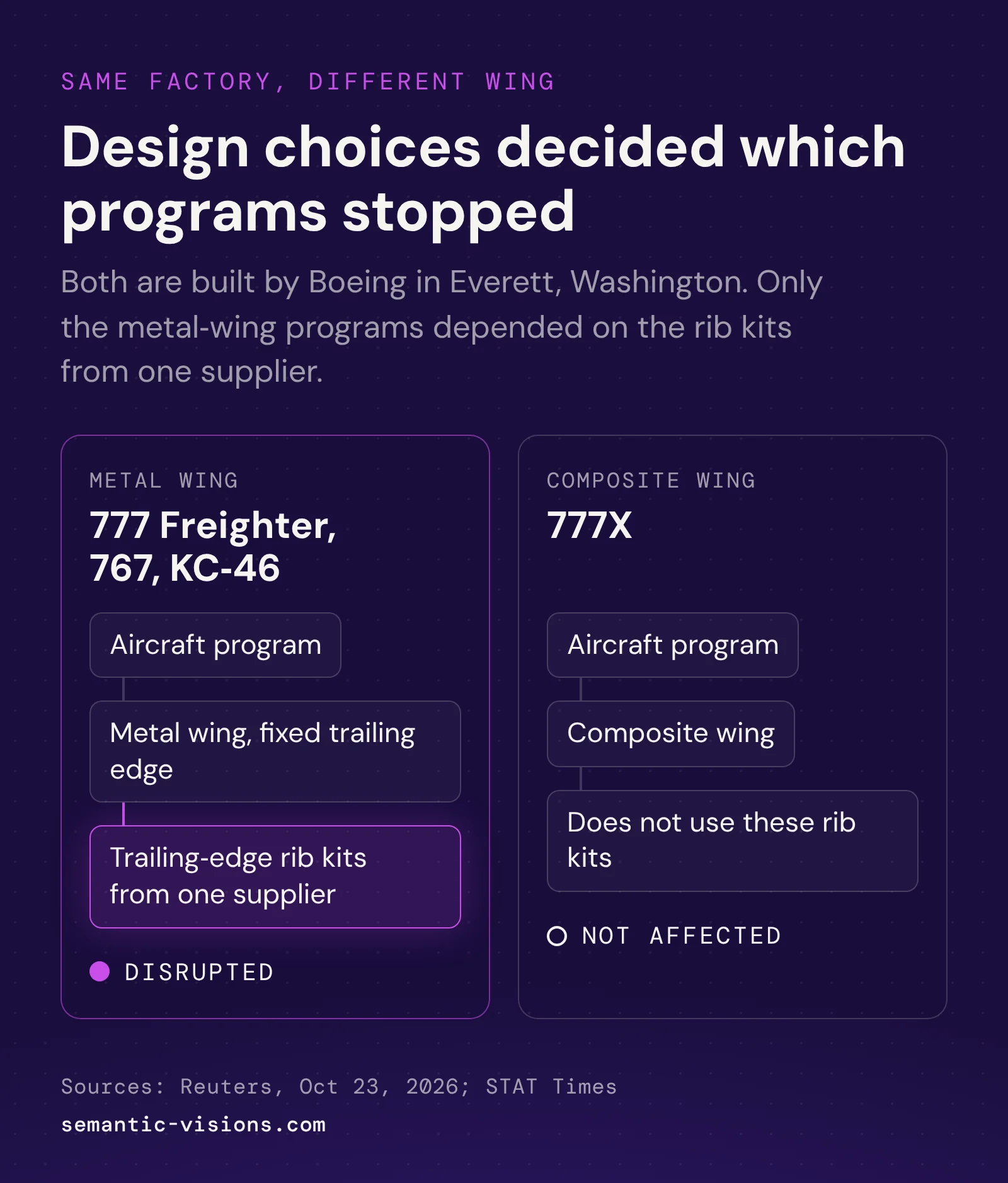
The shortage did not stop at one aircraft. Production of the 767, including the KC-46 military tanker, was also disrupted. The newer 777X was not affected, because its wings are made of composite materials and do not use these rib kits.
How did a supplier dispute reach FedEx?
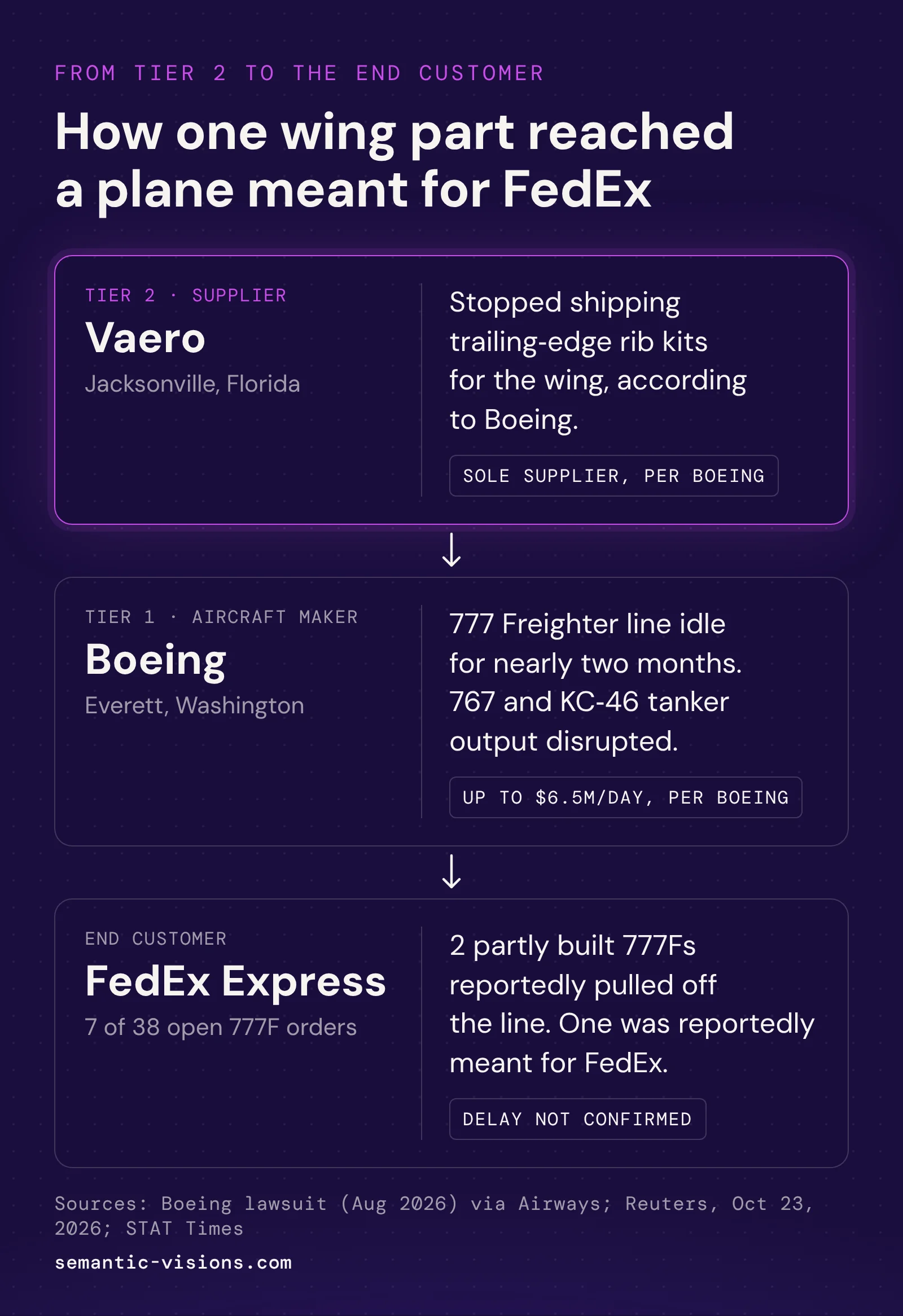
The problem moved two steps down the supply chain. A Tier 1 supplier sells directly to a company. A Tier 2 supplier sells to that Tier 1 supplier. From FedEx's point of view, the chain looked like this:
- Tier 2, the parts supplier: Vaero, in Jacksonville, Florida. It stopped delivering wing parts, according to Boeing.
- Tier 1, the aircraft maker: Boeing. Its 777 Freighter line in Everett, Washington, stood still for nearly two months.
- The end customer: FedEx Express. At the end of September, FedEx had seven 777 Freighters on order, the most of any named customer. In total, 38 of these planes were still on order.
According to a Boeing worker who spoke to Reuters, two partly built 777 Freighters were taken off the final assembly line. Using data from IBA, Reuters identified one of them as meant for FedEx. FedEx did not respond to Reuters.
FedEx bought airplanes from Boeing, not wing parts from Vaero. Even so, a plane reportedly meant for FedEx came off the line unfinished. Public reports do not say whether FedEx's delivery was delayed. Reuters also reported that some freighters with wings built before the dispute could still be delivered by the end of the year.
Were there public warning signs before the line stopped?
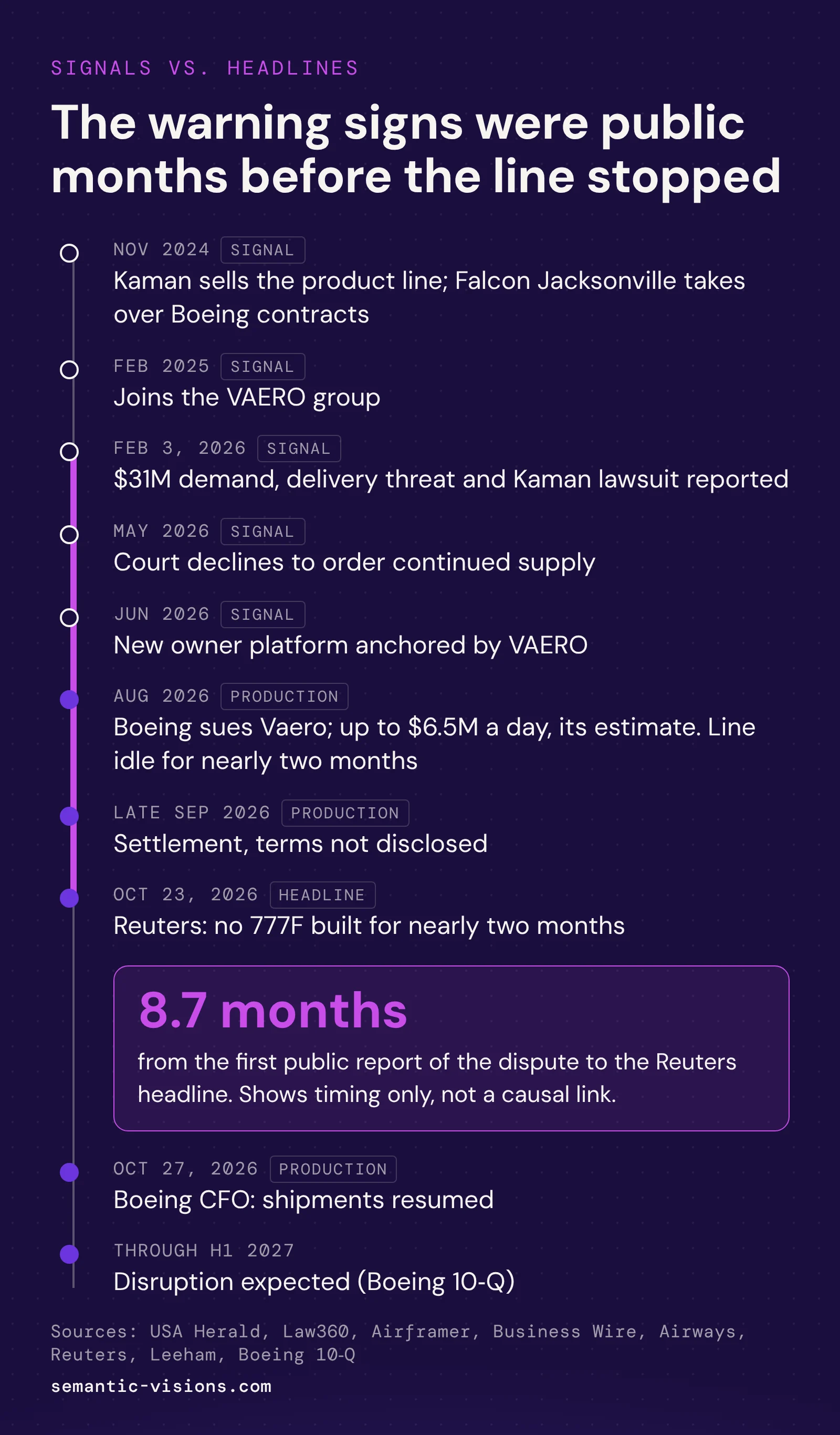
Yes. A legal dispute about this supplier's deliveries to Boeing was public from February 3, 2026. That was about six months before Boeing's own lawsuit and more than eight months before the Reuters report on the production stop.
Court papers filed by Kaman, as reported by Law360 and USA Herald, said:
- Falcon Jacksonville told Boeing it would stop deliveries from February 1 unless it received an extra $31 million above the agreed price.
- Boeing told Kaman it would pay the $31 million and then seek the money back from Kaman under a 2019 guarantee.
- Kaman sued Falcon Jacksonville in the Delaware Court of Chancery and asked for an order to keep the supplies going.
In May, the court declined both to fast-track the case and to order continued supply.
The supplier's ownership and structure also changed several times in a short period. Kaman sold the product line in November 2024. Falcon Jacksonville joined the VAERO group in February 2025. In June 2026, Cendry Capital launched a new platform anchored by VAERO. All three events were public.
Public reports do not say whether the January threat involved the same wing parts, or how it relates to the August stop. None of these events proves a cause. What is clear is the timing: the signals were public long before the headlines.
Is the disruption over?
Not yet. On October 27, Boeing's chief financial officer, Jay Malave, said shipments from the supplier had resumed. He added: "There will be a gap in our production system that gradually flows through these production lines over the next few quarters."
In its quarterly report, Boeing said parts shortages from a key 777 supplier have disrupted its factory, and it expects this to continue through the first half of 2027. Boeing did not name the supplier there either. According to Reuters, Boeing is also trying to make the rib kits itself. As of November 10, 2026, a restart of 777 Freighter production had not been publicly confirmed.
What this case teaches supply chain and risk teams
- One part can stop a whole line. According to Boeing, one company was the only source of a part it could not build wings without.
- Spend is not criticality. A rib kit is a small line on a bill of materials. Supplier monitoring ranked by spend would put it near the bottom. The question that matters is which parts have no second source.
- Risk travels through tiers. FedEx bought planes, not wing parts. Still, a plane reportedly meant for FedEx was pulled off the line, two steps away from where the problem started.
- Ownership and legal changes are signals. A sale, a new group owner, a price demand and a court case involving this supplier were all public months before the line stopped.
- Design choices create or remove dependencies. The 777X, with a composite wing that does not use these rib kits, was not affected.
- The effects outlast the dispute. The companies settled in September. Boeing still expects disruption through the first half of 2027.
Most companies know their direct suppliers well. Fewer know who supplies those suppliers, which of them is the only source of a critical part, or when that supplier changes hands. This case shows why that second step matters.
Mapping suppliers beyond Tier 1 starts with the bill of materials.
Read how multi-tier supply chain mapping works →
Sources
- Reuters, full text via KFGO, October 23, 2026
- Reuters via STAT Times, October 2026
- Airways Magazine
- Leeham News, October 27, 2026
- ch-aviation
- USA Herald, February 3, 2026
- Law360, February 3, 2026
- Law360, May 7, 2026
- Airframer, Falcon Jacksonville joins VAERO
- Business Wire, Cendry Capital launches platform anchored by VAERO, June 16, 2026
- Boeing Form 10-Q, Q3 2026
Frequently asked questions
What happened between Boeing and Vaero?
In August 2026, Boeing sued Vaero, a supplier in Jacksonville, Florida, saying it had stopped delivering trailing-edge rib kits for the wing. According to Reuters, Boeing's 777 Freighter line then stood still for nearly two months. The companies settled in late September.
What are trailing-edge rib kits?
They are sets of ribs that shape the rear section of an aircraft wing and support its skin. According to Boeing's lawsuit, it could not finish a 777 wing or join it to the fuselage without them.
Was FedEx affected by the 777 Freighter halt?
According to Reuters, two partly built 777 Freighters were pulled off the line, and one was meant for FedEx, based on data from IBA. Public reports do not say whether FedEx's delivery was delayed.
How much did the disruption cost Boeing?
In its lawsuit, Boeing estimated the cost at up to $6.5 million a day. That is Boeing's own estimate, not a confirmed figure. Boeing's CFO said the impact was not material to the third quarter of 2026.
Were there warning signs before production stopped?
Yes. On February 3, 2026, legal news reported that the supplier had threatened to stop deliveries to Boeing unless it received an extra $31 million, and that Kaman had sued it in Delaware. That was more than eight months before Reuters reported the production stop.
What is a Tier 2 supplier?
A Tier 2 supplier sells to your direct (Tier 1) supplier rather than to you. In this case, Vaero was a Tier 1 supplier to Boeing and a Tier 2 supplier from FedEx's point of view.
Access Premium Insights



See Everything. Focus on What Matters.
svEye™ filters the noise to uncover meaningful patterns and insights. Gain clarity, stay informed, and drive smarter decisions with a comprehensive overview.

