
Multi-tier supplychain mapping that goes deeper than tier 1.
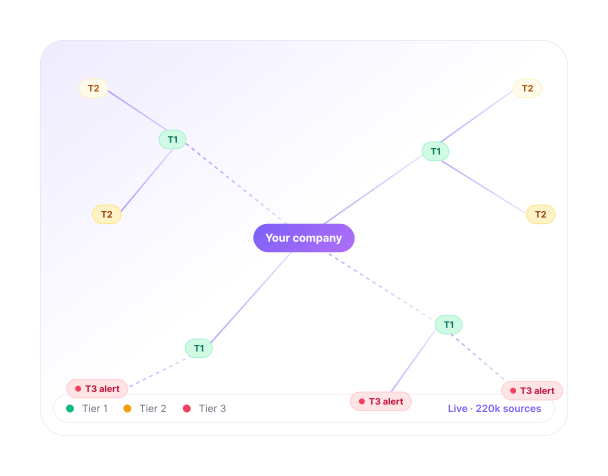
See your suppliers across tier 2, tier 3 and beyond. Detect disruptions in 12 languages, weeks before mainstream media— combining OSINT, customs records and your Bill of Materials into a single live supplier graph.
Trusted by procurement, ESG and risk teams across automotive, aviation, semiconductor and defence supply chains.
220,000+
sources continuously crawled
2M+
documents processed daily
12
languages natively supported
10M+
companies in entity graph
22 days
avg. lead time on disruption
720+
event types pre-classified
Tier-1 visibility is not supply chain visibility.
Most companies know their direct suppliers. Few know who supplies their suppliers. When a flood, factory fire or sanction hits at tier 2 or tier 3, you find out from thenews — same as your competitors. By that time, your production line is already affected, your CFO is already issuing a profit warning, and your alternative supply has been claimed by someone faster.
The risks live underneath.
Continuous, AI-driven multi-tier
visibility — built on three foundations.
Discover who supplies your suppliers.
We map suppliers across tier 1, tier 2, tier 3 and beyond using OSINT, customs records and your Bill of Materials. No supplier questionnaires. No manual research projects.
See disruptions before mainstream media.
We continuously monitor 220,000+ sources in 12 languages, classifying events into 720+ types. Risk signals reach you in minutes —typically days or weeks ahead of business press.
Understand what each disruption means for you.
We connect events to specific suppliers, components and facilities — overlaid onyour supply graph. You see not just "what happened" but "which of my products are affected".
Four steps from supplier list to actionable intelligence.
Onboard
Upload your direct supplier list— we handle very large lists (tens of thousands of entities). We cleanse, deduplicate, validate against entity registries and assign canonical IDs.
Enrich
We attach context to eachentity: HS codes for what they supply, supplier type(producer, manufacturer,distributor, service provider),supply type (raw material,component, sub-assembly, final product), geographic andregulatory exposure.
Map
We discover tier 2, tier 3 anddeeper suppliers through acombination of: OSINT (mediamentions, contractannouncements, M&A coverage), customs records(Bill of Lading data,transshipment routes), andcustomer-provided BoM whereavailable. Cross-validationincreases confidence thedeeper we go.
Monitor
The mapped graph is continuously monitored. Any of 720+ event types affecting any mapped entity — financial distress, regulatory action, ESG controversy, physical disruption, sanctions, ownership change — surfaces as a prioritised alert in your existing tools.
The three inputs that make tier-3 mapping accurate.
Most platforms map only what suppliers self-report. svChain combines public signals with structured trade data and your own product specifications — triangulating relationships that single-source tools cannot see.
Harmonized System codes
The 6–10 digit international classification system used in customs declarations worldwide. We attach HS codes to suppliers based on what they actually ship — not what they claim to specialize in.
HS codes let us validate tier-2 and tier-3 relationships with structured trade data, not just media mentions — and unlock commodity-specific risk monitoring.
Bill of Materials
A list of every part, sub-assembly and material that goes into each of your finished products — typically maintained in your PLM or ERP system.
When you provide your BoM, we pinpoint whichfinished products are affected by any disruption —not just "supplier X has a problem".
Bill of Lading
Public shipping manifests filed with customs authorities, recording every cross-border container shipment: shipper, consignee, HScode, port pairs, dates, weights, container counts.
BoL data is the single most powerful signal for discovering undisclosed tier-2 and tier-3 relationships. It shows actual physical trade flows.
The triangulation effect.
Each input alone has gaps — OSINT misses private deals, BoL misses domestic shipments, BoM only covers what you already know. Together, they cross-validate each other and reach mapping confidence levels that single-source platforms cannot achieve.
Six capabilities that turn supplier data into supply chain resilience.
Multi-tier mapping
Tier 1 to tier 3+ discovery. Build a complete supplier graph from open and licensed sources — without questionnaires, without depending on supplier cooperation, without 6-month consulting projects.
Concentration risk visualisation
Single points of failure, surfaced. Identify suppliers who appear repeatedly in your graph, geographic clustering of critical inputs, and commodity bottlenecks before they become crises.
Real-time event detection
720+ event types, 12 languages, sub-minute latency. From financial distress and regulatory action to factory fires and labour disputes —every event affecting your mapped suppliers reaches you in real time.
ESG & CSDDD evidence
Continuous due diligence audit trail. Automated monitoring of supplier ESG controversies — labour, environmental, governance — with time stamped evidence for regulatory reporting.
Climate & geopolitical overlay
Risk beyond financial signals. Weather events, conflict zones, trade-policy changes and sanctions overlaid on your supplier graph. See not just what happened, but where and which suppliers it threatens.
Historical replay
10-year archive for risk modelling. Backtest disruption scenarios, train internal risk models, and analyse past events with full historical context — the same data the engine operates on today.
Real disruptions. Real leadtimes. Real customer outcomes.
Three weeks early on a flood that triggered a Porsche profit warning.
On July 1, 2024, the Rhone River flooded Novelis's aluminium plant in Sierre, Switzerland. svChain detected the disruption the same day, alerting customers whose graphs included Novelis as a tier-2 supplier — including those buying through Porsche, JLR and BMW. On July 23, Porsche issued a profit warning. svChain customers had 22 days to secure alternative aluminium supply before the news became public.
Detection
Porsche
warning
JLR impact
BMW impact
Thirteen months of warning signals before bankruptcy.
From early 2023, svChain surfaced a cumulative pattern of distress on Fisker — manufacturing delays, supply struggles, senior management changes, missed production targets, regulatory probes, partnership failures. Each individual signal was weak. The combination, surfaced through correlation analysis, was unmistakable. Customers exposed to Fisker as tier-2 or tier-3 had over a year to migrate before the Chapter 11 filing in June 2024.
750+ export-control violations across tier-2 defence subcontractors.
svChain detected over 750 export-control violations disclosed by RTX Corporation through Collins Aerospace — including transfer of sensitive technical data to Chinese subcontractors used in U.S. defence systems. For NATO and allied buyers using RTX as a tier-1 supplier, svChain mapped the cascade: which of their own systems contained components traced to Chinese manufacturing.
What svChain does for your role.
"Where am I exposed in tier 2 and tier 3?"
Concentration risk dashboards surface single-source dependencies, geographic clustering, and commodity bottlenecks across your full supplier graph — not just direct relationships.
Identify that 73% of your tier-2 lithium supply traces back to a single Chinese province, three months before sanctions or export controls become a possibility.
"By the time I read about it, my line is already down."
Real-time alerts on 720+ event types affecting your mapped suppliers — typically days to weeks ahead of mainstream business press.
22-day lead time on Novelis flooding before Porsche issued its profit warning (July 2024).
"CSDDD requires evidence I cannot manually gather."
Continuous, timestamped monitoring of ESG controversies across your supplier graph — including local-language sources that English-first tools miss. Output is audit-ready.
Automated detection of forced labour allegations against a tier-2 textile supplier in 8 hours, with source verification — vs. 6-month manual audit cycles.
"Which of my products is affected by this disruption?"
When you provide your Bill of Materials, we don't just flag suppliers — we trace component impact through to your finished goods.
A factory fire at a tier-3 capacitor manufacturer immediately maps to the four EV models in your portfolio that depend on those capacitors.
"I need alternatives — fast."
When a supplier disruption hits, we surface comparable suppliers globally — filtered by HS code, geography, capacity signals and risk profile.
Within minutes of a sanction announcement, see all suppliers shipping the same HS code at comparable scale, ranked by current operational risk.
Built for the regulations you're now obligated to comply with.
CSDDD
Continuous monitoring of supplier human rights and environmental risk across all tiers.
UFLPA
Detection of Xinjiang-region forced labour signals across deeper supply tiers.
Modern Slavery Act
Annual statement evidence — full audit trail of supplier scrutiny.
Bill S-211
Automated risk assessment for forced and child labour signals.
Transparency Act
Public-facing due diligence reporting support.
Company Law (revised)
Stakeholder and environmental impact monitoring.
How svChain is different from alternatives buyers consider.
vs. Supplier self-reporting tools
vs. Tier-1 monitoring platforms
vs. Generic news monitoring
vs. Consultant-driven mapping
Coverage advantage — 12 native languages.
svChain natively processes 12 languages including Mandarin, Russian, Arabic and Persian — capturing local-language signals that English-first competitors miss entirely. The Novelis flood was first reported in Swiss French regional press, hours before any English-language coverage.
Fits into the tools your team already uses.
Procurement & ERP
SAP Ariba · Coupa · Oracle SCM · Microsoft Dynamics
Available on SAP Store: Semantic Visions Commodities Monitoring
GRC platforms
ServiceNow GRC · MetricStream · Diligent · LogicGate
Collaboration & alerting
Slack · Microsoft Teams · email digests · webhook push
API & data delivery
REST API · webhooks · CSV/Parquet bulk export · Kafka streaming on request
Frequently asked questions.
Multi-tier supply chain mapping is the practice of identifying and monitoring suppliers beyond your direct (tier-1) relationships, extending visibility to tier-2 (your suppliers' suppliers), tier-3 (their suppliers in turn) and deeper. Modern multi-tier mapping uses a combination of open-source intelligence (OSINT), customs records (Bill of Lading data), customer-provided Bill of Materials, and entity graph analysis to discover relationships that suppliers do not voluntarily disclose.
svChain combines three independent data sources that don't require supplier cooperation: (1) OSINT — public media coverage, contract announcements, regulatory filings; (2) customs records — Bill of Lading data showing actual cross-border shipments by HS code; (3) customer-provided Bill of Materials — your own product specifications, when available. Triangulating these three sources lets svChain validate supplier-buyer relationships even when neither party has publicly disclosed them.
Tier 1 means your direct suppliers — companies you contract with directly. Tier 2 means your suppliers' suppliers. Tier 3 means their suppliers in turn, and so on. Most ERP and procurement tools cover tier 1 only, because that's where contracts and invoices live. Tier 2 and beyond require external intelligence — which is where svChain's combination of OSINT, customs records and BoM analysis becomes essential.
svChain continuously crawls 220,000+ sources in 12 languages — including local-language regional press, industry trade publications, regulatory filings, and customs declarations. Disruptions almost always appear in local sources before they reach mainstream business press. The Novelis flooding in July 2024 was first reported in Swiss French regional press hours before any English-language coverage and 22 days before Porsche issued its public profit warning.
HS (Harmonized System) codes are the 6–10 digit international classification system used in customs declarations worldwide. Every cross-border shipment carries an HS code. svChain uses HS codes to validate supplier-buyer relationships through customs records — for example, a Bill of Lading showing Hindalco Industries shipping HS 7604 (aluminium) to Apple Inc. confirms a tier-2 relationship even when Apple has never publicly disclosed Hindalco as a supplier.
A Bill of Materials (BoM) is the structured list of components, sub-assemblies, raw materials and parts that make up a finished product — typically maintained in your PLM or ERP system. When you provide your BoM, svChain can trace any disruption to specific finished products. Not just "supplier X has a problem" — but "supplier X provides cathode material used in your Model Y battery, manufactured in Plant 3, currently representing 18% of Q3 production".
A Bill of Lading is the legal shipping document filed with customs authorities for every international cargo movement. It records the shipper, consignee, HS code, port of origin, port of destination, container counts, and dates. BoL records are publicly available in many jurisdictions and represent the single most powerful signal for discovering undisclosed tier-2 and tier-3 supplier relationships — because they show actual physical trade flows, not what companies choose to publicize.
Industries with deep, multi-tier supply chains and high disruption sensitivity: automotive (and particularly EV), aviation and aerospace, semiconductors, pharmaceuticals, defence, consumer electronics, and energy. Any industry subject to CSDDD, UFLPA, Modern Slavery Act or similar supply-chain due diligence regulations also benefits — svChain provides the audit-ready evidence trail those frameworks require.
Yes. svChain provides timestamped, source-cited evidence of continuous supplier monitoring for human rights and environmental risk across all tiers — exactly what the EU Corporate Sustainability Due Diligence Directive (CSDDD), in force since July 25, 2024, requires. The same evidence trail supports UFLPA (USA), Modern Slavery Act (UK), Bill S-211 (Canada), Transparency Act (Norway) and similar regulations globally.
svChain is priced based on supplier graph size (number of entities monitored) and event coverage scope (which event types and risk dimensions you require). Pricing scales with supplier count, not user count — so all relevant team members across procurement, ESG, risk and operations can access the same intelligence. Contact us for a quote based on your specific supplier base.
See your supply chain beyond tier 1.
A 30-minute demo shows you exactly what svChain sees in your supplier graph today — including the tier-2 and tier-3 relationships your current tools don't surface.
The complete guide to multi-tier supply chain mapping.
38-page whitepaper covering OSINT vs proprietary data, the legal landscape (CSDDD, UFLPA and 4 more), the SV mapping process, deliverables, and case studies from automotive and aviation.