
Automate adverse media screening, AML checks, and supply chain compliance under DORA, NIS2, CER, and CSDDD
Do you need to meet regulatory requirements that include adverse media search, open-source data lookup, or ESG due diligence across your supplier and counterparty network — without adding 10 analysts?
2M+
Articles/day monitored
12
Languages natively
720+
Event types classified
10+ yrs
Historical screening
One platform. Five major regulatory frameworks.
Select a regulation to see how svCompliance automates the required screening, monitoring, and evidence generation — including national implementations for your jurisdiction.
Anti-Money Laundering (AMLD6+)
Onboarding and ongoing due diligence for companies, individuals, and PEPs — automated adverse media with full evidence pack.
Digital Operational Resilience Act
ICT third-party risk monitoring and concentration risk for EU financial entities — mandatory from Jan 2025.
Network & Information Security
Supply chain cyber risk monitoring with ripple-effect detection across ICT supplier networks. CZ zákon 264/2025 Sb.
Critical Entities Resilience
Concentration and disruption monitoring for critical infrastructure entities. CZ zákon 266/2025 Sb.
Corporate Sustainability Due Diligence
Forced labor, deforestation, child labor, and ESG risk across multi-tier supply chains. German Supply Chain Act.
CSRD & EU Taxonomy
ESG reporting data intelligence layer — in roadmap for Q3 2026.
Automated adverse media for onboarding and ongoing due diligence
For both initial onboarding KYC and continuous ongoing due diligence (ODD), our OSINT platform automates adverse media checks across companies, beneficial owners, and PEPs in 12 languages — with a full traceable evidence pack for regulators.
What does "adverse media check" under AMLD6 actually require?
AMLD6 mandates risk-sensitive screening of customers against negative news — including corruption, fraud, sanctions, and tax crimes — at both onboarding and throughout the relationship. Manual searches are no longer sufficient for high-volume portfolios.
Upload your watchlist or entity list
Paste or upload companies, individuals, or PEPs. Supports CSV, API push, or direct integration into your existing workflow.
One-time onboarding check or continuous ODD alerting
Point-in-time screening (results within 24h, 10 years historical) or automated ongoing monitoring with hourly alerts when new adverse signals emerge.
Compliance report with full evidence pack
Each flagged entity receives a structured report with source articles, event classification, severity score, and direct source links — audit-ready for regulators.
ICT third-party risk monitoring and concentration risk under DORA
DORA (EU Regulation 2022/2554) requires EU financial entities to continuously monitor ICT third-party service providers — including sub-contractors — for operational risks, incidents, and concentration exposure.
What ICT third-party monitoring does DORA actually require?
DORA mandates that financial entities maintain a register of ICT third-party providers, perform ongoing monitoring for operational disruptions, and identify concentration risk where multiple entities depend on the same critical provider.
Upload your ICT supplier register
Import your ICT third-party provider list — cloud, SaaS, data, and network providers. Map each to your critical functions as required by DORA Article 28.
Automated risk monitoring and alerting
Continuous monitoring of all ICT providers for adverse events: security incidents, regulatory sanctions, financial distress — with hourly updates and severity scoring.
Concentration risk dashboard
Identify which functions rely on a single critical provider. Visualize exposure and generate DORA-compliant concentration risk reports automatically.
Supply chain cyber risk and ripple-effect detection under NIS2
NIS2 (Directive EU 2022/2555, CZ law 264/2025 Sb.) extends cybersecurity obligations to supply chains. svCompliance monitors your ICT and critical suppliers for security incidents and detects how vulnerabilities propagate across interconnected networks.
What supply chain obligations does NIS2 create?
NIS2 requires essential and important entities to assess and manage cybersecurity risks in their supply chains — including software vendors, hardware providers, and managed service providers. Incidents at a supplier that affect your operations must be managed and reported within 24–72 hours.
Map your ICT and critical supplier network
Upload tier-1 suppliers. svChain automatically expands the map to tier-2 and tier-3 — including shared infrastructure providers that create systemic vulnerability exposure.
Real-time incident detection with ripple-effect alerting
When a supplier suffers a security incident, the system immediately flags all your functions that depend on that supplier — direct and indirect — showing potential cascade impact.
NIS2 supplier cockpit and reporting
A live dashboard showing supplier health scores, incident history, dependency mapping, and automated monthly compliance reports.
Critical entity resilience monitoring for infrastructure operators
The CER Directive (EU 2022/2557, CZ law 266/2025 Sb.) requires critical infrastructure operators to assess and manage risks to their physical and operational resilience — including their supplier and partner ecosystem.
What does the CER directive require from critical entities?
Critical entities (energy, transport, health, water, digital infrastructure, finance) must perform risk assessments, monitor for disruptive events, and report significant incidents. The Czech national implementation requires regular supply chain risk assessments and demonstrable monitoring capabilities.
Define your critical operations and supply chain
Upload tier-1 suppliers relevant to your critical functions. The platform maps concentration risks and interdependencies across your operational ecosystem.
Generate supply chain health map with scoring
Each supplier receives a live SV Health Score — a 180-day rolling signal aggregated from 1.9M daily media sources. Concentration risk and geographic exposure are visualized on an interactive map.
Automated resilience reporting
Regular reports on supplier health, disruption alerts, and concentration risk — formatted for submission to national competent authorities.
ESG and human rights due diligence across multi-tier supply chains
CSDDD, the German Lieferkettensorgfaltspflichtengesetz, and related regulations require companies to identify and address human rights and environmental risks across their entire supply chain — not just tier-1 suppliers.
What ESG risks must CSDDD due diligence cover?
CSDDD requires companies to identify, prevent, and mitigate adverse impacts on human rights (forced labor, child labor, unsafe working conditions) and the environment (deforestation, pollution, biodiversity loss) across their supply chain. This must be a continuous process, not a one-time audit.
Map multi-tier supply chain for ESG exposure
Upload tier-1 suppliers. svChain expands to tier-2 and tier-3, identifying production locations, commodities, and regions with elevated ESG risk.
Continuous ESG event monitoring and alerting
Real-time monitoring of all mapped suppliers for ESG-relevant events: labor protests, environmental violations, deforestation reports, sanctions for human rights abuses — across 1.9M daily sources in 12 languages.
Supply chain ESG risk report with drilldown
A visual supply chain map with ESG health scores per node, geographic risk overlays, and supplier-level drilldown showing the specific events that triggered risk flags.
Why svCompliance outperforms manual screening and basic tools
Semantic understanding, not keywords
An article about "alleged misconduct by the CEO of Company X" is caught even when "fraud" is never mentioned. Keyword-based tools miss this.
Multi-language adverse media
Corruption in a Slovenian-language article about a Czech subsidiary is detected, classified, and translated automatically.
Corporate structure & language variants expansion
Screening "ABC Holding" automatically screens for its name variations in other languages and optionally includes subsidiaries, sister companies, and beneficial owners — no manual lookup required.
Full audit trail
Every alert links to the original source article, timestamp, and classification rationale — ready for regulatory audit or internal compliance review.
Access your intelligence the way your team works
svEye application
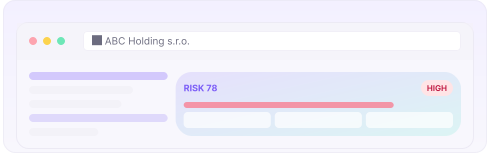
A full browser-based workspace. Search entities, run screening, explorethe knowledge graph, review alerts, and download evidence packs — noinstallation required. Ideal for compliance analysts and risk teamsworking hands-on with the data.
Custom dashboard
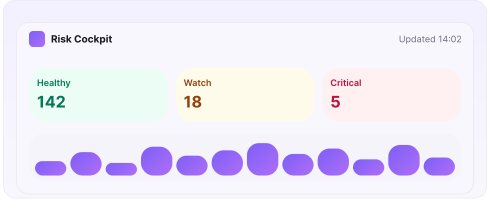
A branded, role-specific view of your compliance intelligence —configured to your entity list, regulatory scope, and alert thresholds. Builtfor management reporting, operational oversight, or integration into anexisting risk cockpit. Updated hourly.
Scheduled reports by email
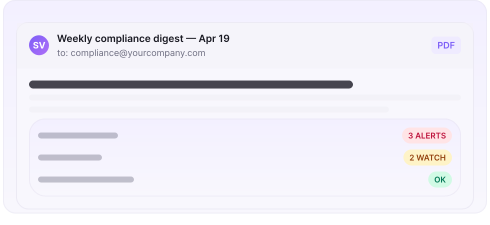
Structured compliance reports delivered directly to your inbox — or yourclient's. Set the frequency (daily, weekly, monthly), the entity scope, andthe output format. Each report includes a full evidence pack with sourcearticles and risk classification, ready for record-keeping.
API
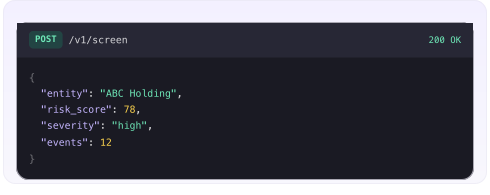
Push entity lists, pull risk scores, and stream alerts programmatically intoyour GRC platform, ERP, data warehouse, or any system with an HTTPclient. Enriched data feeds are also available via cloud storageconnectors — AWS S3, Azure Blob, GCP.
Tell us which regulation you need to solve — get a tailored demo
Share a few details and our team will prepare a live walkthrough using your regulatory scope, jurisdiction, and a sample of your entity list.