
Your AI risk analyst — grounded in real events, not best guesses.
RIA (Risk Intelligence Assistant) lives inside svEye. It reads the dataset you’ve already filtered, answers in natural language, and cites the events behind every answer. No hallucinations. No stale training data. No black box.
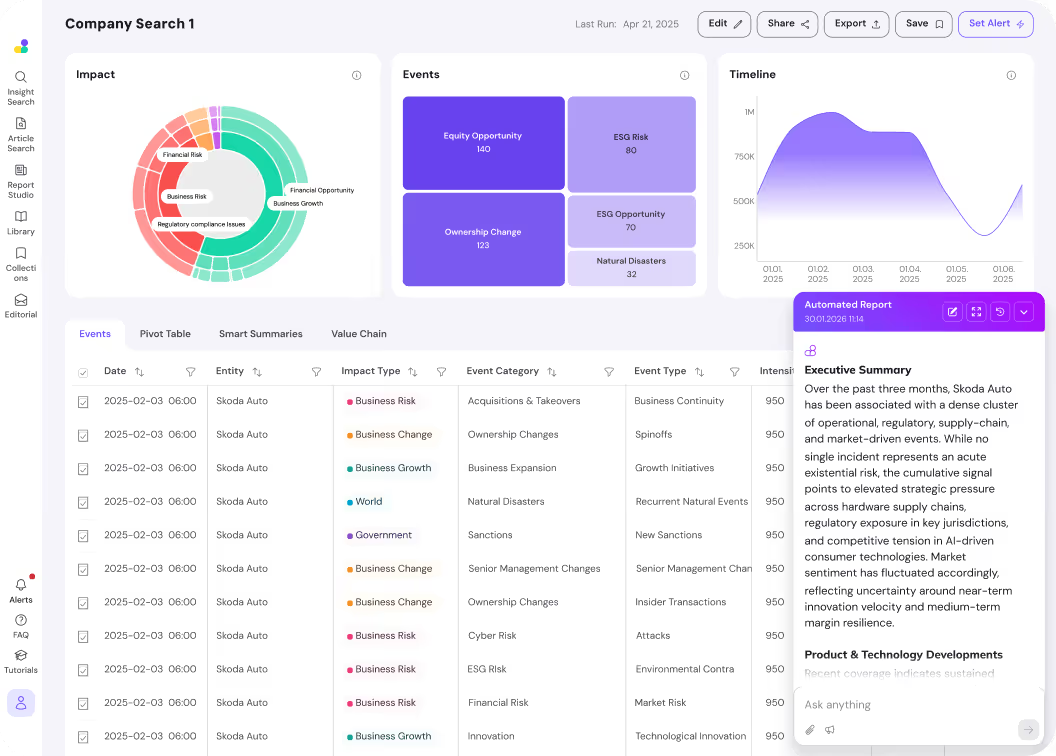
Included with every svEye subscription. Operates on your current filters across Summaries, Pivot Table, Event Table, and Value Chain.
“AI” in risk tools is mostly
a search box with a chatbot skin.
Most “AI assistants” in risk and compliance platforms are wrappers around general-purpose LLMs. They search the public web, summarize what they find, and pass it back. That works for a marketing summary. It fails for a Chief Risk Officer.
Public models hallucinate. They confuse a parent company with its subsidiary. They quote financial data that’s a year out of date as if it happened yesterday. They miss the labor lawsuit that never made the FT but lives in a regional court docket. And — critically — they cannot reproduce the same answer twice, because the web they search keeps changing under them.
That’s a problem when the answer ends up in a board pack.
Ask, and the dataset answers.
RIA operates on whatever you’ve currently filtered in svEye — a watchlist, a sector,
a date window, a single supplier. Four things you’ll do daily:
Summarize the noise
Hand RIA 1,141 summaries from your morning search. Get the five things that actually matter, ranked by potential impact on your entities. Click: “Summarize the results in few points”.
Explain the impact
Pick any event in your filtered view and ask “what does this mean for us?”. RIA frames it in your business context — revenue, supply, compliance, reputation — and ties it to other events in the same dataset.
Get the next question
When you don’t know what you’re looking for, ask RIA to suggest. “What should I be looking at?” Returns the highest-signal anomalies, concentration risks, or sentiment inflections in your current view.
Move from view to action
Ask RIA to draft an internal alert, summarize for a non-technical stakeholder, or pull the supporting events into a shareable list. From insight to artifact in one prompt.
Three things hold RIA to the facts.
Context: your filtered dataset
RIA never starts from a blank prompt. It sees exactly what you see — the entities, date range, event types, and sentiment filters you’ve already applied. The same filters that built your view become the boundary of RIA’s answer.
Source: structured Smart Summaries
Behind RIA sits svEye’s proprietary event database — millions of articles a day, in 12+ languages, mapped to 710+ event types and 10,000+ semantic categories. RIA queries this structured layer, not the open web. Every claim is traceable to a specific event, with a true timestamp and a recognized entity.
Output: verifiable, reproducible
Run the same query tomorrow. You’ll get the same answer (plus anything new that happened in between). That’s not how public LLMs work. It’s how audit-grade intelligence has to work.
RIA vs a general-purpose AI assistant
Every risk platform markets “AI.” Almost all of them are RAG pipelines or ChatGPT API calls
on top of unstructured news. RIA is grounded in a taxonomy-driven event database with true timestamps.
Three days in a risk team.
Morning Triage
You ran the overnight adverse-media search on 4,200 counterparties. RIA ranks the top 12 cases worth a deeper look — sorted by severity and your internal risk appetite. Triage that used to take 90 minutes takes 9.
Supplier Event
A Tier-2 supplier shows up with a SUPPLY_DISRUPTION event in Mexico. You ask RIA: “how many of our Tier-1s depend on this entity?” RIA reads the Value Chain context, links the events across tiers, and drafts the email you’ll send to category management.
Earnings Prep
You’re long Apple ahead of WWDC. You ask RIA: “what’s the impact picture on Apple in the last 60 days?” RIA pulls margin trajectory, supply concentration, AI competitive positioning, and regulatory pressure — each line linked to specific events with dates and sources.
Where you’ll find RIA.
RIA opens as a panel on the right side of every svEye view — Summaries, Pivot Table, Event Table, Value Chain. It sees the filters you’ve set on the main view. There’s no separate workspace, no extra login, no second product to provision. If you have svEye, you have RIA.
Inside every view
Summaries · Pivot · Events · Value Chain
Context-aware
operates on your current filters
Earnings Prep
enterprise SSO · workspace history saved
“Same query tomorrow, same answer — plus whatever happened in between. That’s the baseline for audit, regulatory submissions, and board reporting.”

710+
Event types
10k+
Semantic categories
Frequently asked questions.
The Intelligence Assistant — internally referred to as RIA (Risk Intelligence Assistant) — is an AI conversational layer inside Semantic Visions’ svEye platform. It lets risk, compliance, procurement, and investment teams ask questions in natural language about their currently filtered risk intelligence dataset and receive structured, verifiable answers grounded in svEye’s proprietary event database.
ChatGPT, Gemini, and similar general-purpose LLMs answer from public web content and training data. They can hallucinate, present outdated information as current, confuse related entities, and produce different answers to the same question over time. RIA is grounded in Semantic Visions’ structured Smart Summaries database — a taxonomy-driven repository of business events with true timestamps and disambiguated entities. Queries are deterministic, reproducible, and auditable.
RIA operates on the dataset you’ve filtered inside svEye, drawn from Semantic Visions’ OSINT event database covering millions of sources across 12+ languages. Filters can be scoped to your watchlists, entity lists, sectors, regions, and date ranges — including data feeds enriched with your own entity universe.
RIA’s answers are traceable to specific events in svEye, each with a source URL, true timestamp, and recognized entity. Queries are reproducible — running the same prompt on the same dataset returns the same answer, which is a baseline requirement for audit, regulatory submissions, and board reporting. RIA does not generate factual claims that cannot be linked back to underlying events.
RIA accepts prompts in major business languages and operates on Semantic Visions’ multilingual event database covering 12+ source languages — including Mandarin, Arabic, Russian, German, French, Spanish, Portuguese, and others. Answers are returned in English by default, with the source events linked in their original language.
Yes. RIA is included with every svEye subscription. There is no separate seat, license, or quota — it is a feature of the platform, not a paid add-on.
See RIA work on a dataset that looks like yours.
A 30-minute walkthrough. We’ll load svEye against a sample of your entities, suppliers, or portfolio — and let RIA answer the questions your team actually asks on a Monday morning.

