


Most supply chain teams do not have a news problem. They have a timing problem. By the time a disruption shows up in a quarterly earnings call, a trade publication, or a customer escalation, the window for cheap options (a second source, a reroute, an early inventory build) has already closed.
The question "what is the best tool for monitoring global news and detecting supply chain risks before they blow up" sounds like a shopping question. In practice it is an evidence question. Which tool tells you something happened, to whom, when it really happened, and where you can verify it? Below is the selection lens we use when we talk to risk and procurement leaders, followed by how we think a tool should be tested and put to work. We build svEye™ at Semantic Visions, so we are not neutral, but the checklist applies to any vendor, including us.
Media monitoring and OSINT risk intelligence are different products
The two categories get lumped together, and the confusion costs teams months.
Media monitoring takes keywords and returns articles. You get a feed, and an analyst reads it, decides what matters, identifies the company, checks whether it is a subsidiary of something you care about, and works out when the event started. The tool collects, and the human does the intelligence work.
OSINT risk intelligence turns open-source content into classified events tied to resolved entities. A flood is tagged as a flood. The affected plant is linked to the right company, and the company is linked to your suppliers. The event carries a timestamp for when it occurred, which is often different from when someone wrote about it, and a link back to the source article.
A simple rule of thumb: if the tool only returns articles, you are buying a reading list. If it returns events with entities, event types, time, and source links, you are buying intelligence.
The distinction matters for defensibility too. When a compliance officer or a board member asks why a supplier was flagged on a given date, "our keyword alert fired" is a weak answer. "Here is the classified event, the true event time, and the source article" holds up in a review.
What early detection should mean for supply chain risk
"Early" gets used loosely in vendor marketing. For a supply chain team it should mean detecting a specific set of operational events at your suppliers, and at their suppliers, before your own company is named in the news:
- production halts at a plant you depend on
- floods, fires, and other physical disruptions near supplier sites
- strikes and protests that affect output or logistics
- sanctions that touch a supplier or its owners
- insolvency signals, such as unpaid wages, order failures, or lawsuits from customers
Each of these has a minimum evidence standard. At a bare minimum, you should expect an event type from a defined taxonomy, a resolved entity (the actual company, not a string match), and a link to the underlying source. Without those three, an alert is a rumor with a timestamp.
Signal density beats hit counts
Vendors love to quote volume: millions of documents, billions of data points. Volume tells you how much the tool reads. It says nothing about how much of what it returns is useful.
A more honest measure is signal density: the share of what lands in front of an analyst that is relevant, classified, and attributable to an entity you care about. A tool that returns 4,000 keyword hits for a supplier name has pushed work onto your team. A tool that returns three classified events, each tied to the right legal entity, has done some of it for you.
Alert fatigue is a real cost. We wrote more about it in our piece on early-warning risk intelligence, but the short version is that teams stop trusting feeds that cry wolf, and then they miss the one alert that mattered.
The checklist I would use before trusting a vendor
If I were evaluating tools for a procurement risk or third-party risk function, these are the six questions I would put to every vendor, in roughly this order.
1. How wide is the source coverage, and how often does it update?
Ask for numbers, and ask how often the data refreshes. svEye reads roughly 2+ million articles a day, drawn from around 900,000 sources, with hourly updates. Whatever tool you test, find out whether the cadence is hourly or daily, and whether it holds steady on weekends and holidays. Disruptions do not wait for Monday.
2. Does it work in the languages your suppliers operate in?
This is where many global news monitoring setups quietly fail. A flood in a Swiss canton, a strike in a Bangladeshi industrial zone, or a wage dispute at a Czech energy company is often reported first, and sometimes only, in local-language media. English-only coverage sees these events late or never.
svEye covers more than 12 global languages. Match that number against your own supplier footprint. If your Tier 2 and Tier 3 base sits in countries where English-language press is thin, multilingual OSINT is not a nice-to-have. Our white paper on native-language intelligence walks through case studies where the disruption was public, just not in English.
3. Can it turn unstructured text into standardized event types?
A taxonomy is what makes events comparable, filterable, and routable. svEye classifies more than 700 types of business, geopolitical, and operational events, and links them to companies, commodities, industries, and locations. Ask any vendor for their taxonomy, and check whether it covers the scenarios you actually worry about, from plant shutdowns and sanctions to executive departures and litigation.
4. How good is the entity resolution?
This is the least glamorous item on the list and often the most decisive. Company names appear as abbreviations, with and without diacritics, in non-Latin scripts, and as subsidiaries or branches of a parent. If a tool cannot tell the parent from the subsidiary from the branch, it will either miss events or flood you with false matches.
The approach we take in svEye is entity resolution across name variants, abbreviations, diacritics, and non-Latin scripts, with a distinction between parent, subsidiary, and branch. When you run a trial, bring a messy supplier list and see what happens to it.
5. Can it see beyond Tier 1?
Most disruptions that hurt manufacturers start further up the chain than the supplier on the purchase order. Tier 1 is usually the best-documented layer. Tiers 2 and 3 are where visibility thins out, and where tier 2 supplier monitoring and tier 3 supplier risk analysis either exist or do not.
svEye derives supplier relationships from open sources, up to three tiers deep via a connector, and deeper multi-tier mapping is available as a service. There is also a related capability worth testing: indirect alerting, where an event at a location raises an exposure alert for suppliers based there. Our page on multi-tier supply chain mapping covers how this works in practice.
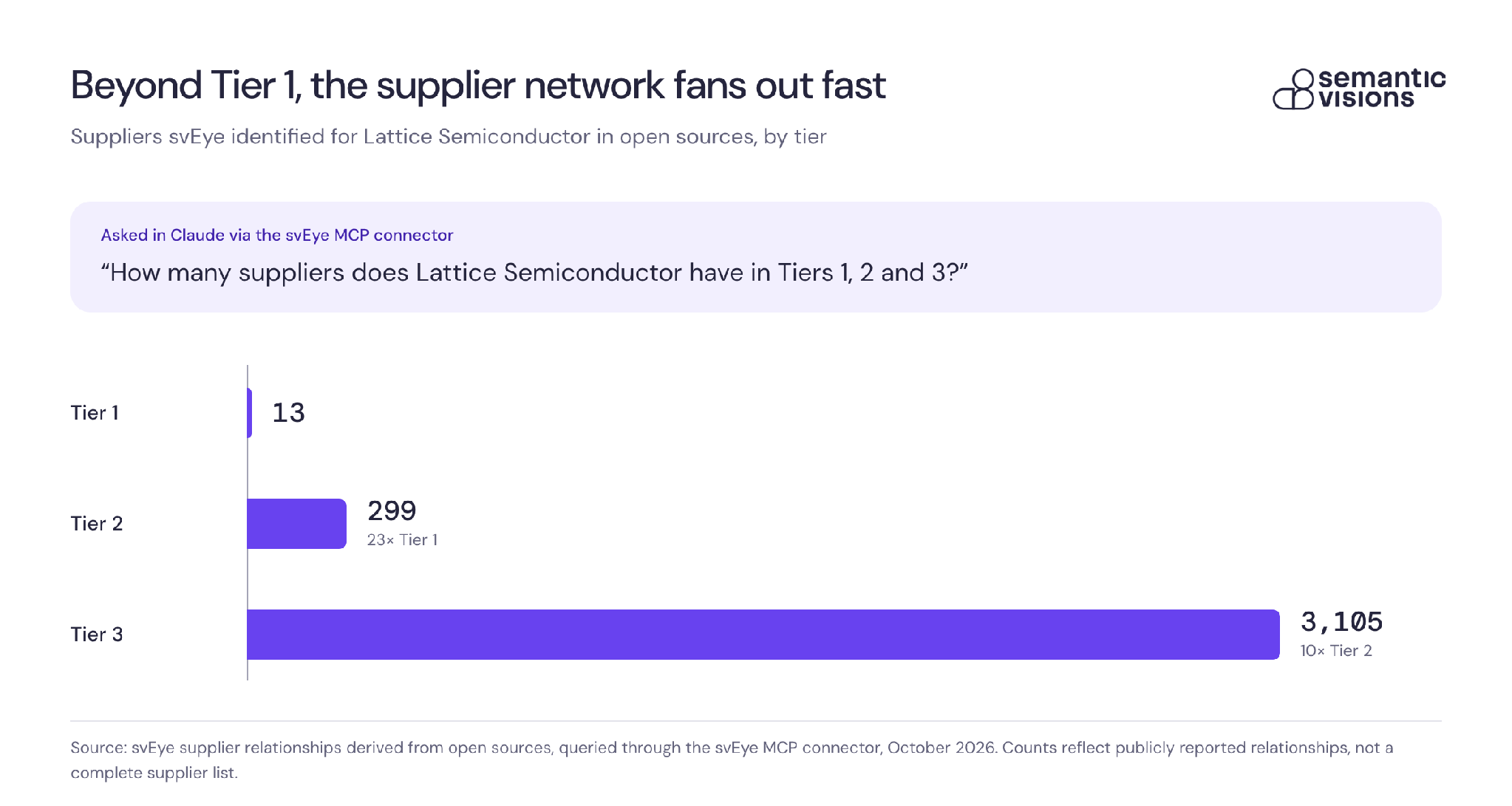
To give a sense of scale, here is what svEye found for one company, the FPGA maker Lattice Semiconductor. Thirteen Tier 1 suppliers turn into almost 300 at Tier 2 and more than 3,000 at Tier 3.
Open-source mapping has limits. It reflects what is publicly reported, so it complements supplier questionnaires and contractual disclosure rather than replacing them. Any vendor claiming complete sub-tier visibility from public data alone deserves a follow-up question.
6. Does it fit the way your team already works?
A brilliant signal that lives in a separate portal nobody opens is wasted. Look for dashboards and real-time alerts for analysts, plus programmatic access for everyone else. svEye offers a REST API for risk events and an MCP connector for Claude, so analytics teams can query events from their own tooling or pull them into AI-assisted workflows. The tier counts in the Lattice Semiconductor chart above came from a single question asked in Claude through that connector.
Where most tools fall short
Having read a fair amount of vendor and publication content on this topic, the same gaps keep appearing. Ranked lists of supplier risk tools usually give each product a short paragraph and move on. They rarely say how to choose, what to test, or what differentiates one approach from another. General OSINT advice tends to stay at the level of tool categories (news aggregation, social listening, threat intelligence) without a repeatable workflow or measurable evaluation criteria.
On the product side, the shortfalls cluster in three areas:
- Depth below Tier 1. Many platforms assess direct suppliers well and go thin after that.
- Event structure. Some tools surface articles and mentions without classifying what actually happened.
- Timing integrity. When a platform only records when an article was published, you lose the difference between when something occurred and when it was reported.
The market has capable players. Supply chain risk platforms such as Interos, Prewave, Everstream Analytics, and Resilinc, and event and media intelligence services such as Dataminr and Recorded Future, each have their own strengths and focus. I would not try to rank them here. I would run the same six questions against whichever shortlist you build and compare the answers side by side.
What we think distinguishes svEye is the combination: a high-volume multilingual read, 700+ event types, entity-resolved and time-stamped events, up to 10 years of historical depth for back-testing, and multi-tier supplier relationships built from open sources. The platform description on the svEye page covers the full feature set.
Three examples worth using in your internal evaluation
Claims are cheap. Timelines are better. These are the cases we would use to pressure-test any tool, ours included, because each can be checked against public coverage.
Swiss floods, July 2024
On 1 July 2024, flooding in the Valais region of Switzerland halted Novelis' Sierre aluminium plant. svEye detected the event and alerted clients to exposure at Porsche, Jaguar Land Rover, and BMW. That was weeks before Porsche issued its profit warning on 23 July, and before press coverage of production impacts appeared between 1 and 4 August.
The pattern is the one buyers care about. A local physical event, a Tier 2 or Tier 3 supplier relationship, and a downstream impact on well-known manufacturers that only became a headline later. The useful question for any vendor is whether the alert arrived with the right entities attached, not just whether the flood was detected.
Bangladesh protests, October and November 2023
During the protests in Bangladesh in late 2023, svEye generated alerts on H&M suppliers Shasha Denims and Pacific Jeans before H&M itself was named in the media as affected. This is the pre-naming window in action. The buyer's name was absent from the coverage, but the supplier's was present, and an entity-resolved system can connect the two.
Energetický Holding Malina, Czech Republic
Distress rarely arrives as a single event. For Energetický Holding Malina, early-warning signals including unpaid wages, order failures, customer lawsuits, and asset transfers were tracked from January 2023. The company filed for insolvency on 6 May 2023.
No single signal in that sequence is conclusive. Taken together, with true timestamps and source links, they form a distress sequence that a risk analyst can defend. Our article on why generative AI alone is not enough uses the same case to show why regional, multilingual coverage matters.
What ties the three together is defensibility. Each has a time frame, event evidence, and source-linked outcomes you can show to a stakeholder. When you test a vendor, ask for the same kind of timeline on a disruption you already know about.
How I would put a tool to work in week one
A trial that starts with "let us see what the feed shows" tends to produce an interesting week and no decisions. A more productive start is narrow and specific.
Day one and two: build the watchlist. Load your Tier 1 suppliers, then add known indirect exposures: critical Tier 2 and Tier 3 names, key sites, and the commodities you cannot easily substitute. Messy names are fine, and in fact helpful. They show you how entity resolution handles real data.
Day three: choose the event types. Resist the urge to switch on everything. Pick the dozen or so that match your actual loss scenarios, such as plant shutdowns, floods, strikes, sanctions, and insolvency indicators, and set aside the rest for later.
Day four: route alerts to people. Send procurement risk events to the category managers who can act on them, and sanctions and adverse media events to compliance. The same open-source layer also supports adverse media screening, perpetual KYB monitoring, and AML, KYB, and KYC workflows, so one deployment can serve both teams if it is configured sensibly.
Day five: back-test. Use the historical depth (svEye keeps up to 10 years) to replay a disruption your company lived through. Check when the platform would have flagged it, compare that date to when your organization found out, and record the gap. That gap is the most honest ROI estimate you will get during a trial.
After the first week, push structured output into the systems your analysts already use. Exports and reports serve stakeholders who want a summary, while API access serves data teams who want to model exposure or combine events with internal spend and inventory data.
The decision comes down to evidence
The best tool for monitoring global news and detecting supply chain risks early is the one that produces verifiable, entity-linked, time-aware events at the depth your exposure requires. For some companies that means Tier 1 is enough. For manufacturers whose real vulnerabilities sit two or three layers down, it means multi-tier visibility and multilingual coverage are non-negotiable.
Take the six questions above to every vendor on your list, ours included. Ask for timelines on events you already know. Check what happens to a messy supplier list. Look at the gap between when something happened and when it would have reached you.
If you want to run that test on svEye, we are happy to set up a focused evaluation view around your own suppliers and a past disruption of your choosing. Reply with the scenario that cost you the most, and we will show you what the signal looked like at the time.
Access Premium Insights



See Everything. Focus on What Matters.
svEye™ filters the noise to uncover meaningful patterns and insights. Gain clarity, stay informed, and drive smarter decisions with a comprehensive overview.

