
Open-source sensing for operational warning and decision advantage.
Semantic Visions converts multilingual open-source signals into source-traceable warning products for defense mission owners — across DIB exposure, counter-proliferation, contested logistics, economic security, cognitive warfare and illicit networks.
12+
source languages
global, persistent multilingual detection
710+
mission event types
10k+
semantic categories
24/7
monitoring fordecision-relevant change
Not another raw feed.
Decision-ready warning products.
Raw feeds give you volume
Volume is not warning – analysts still needcorrelation, source provenance, confidence, and a decision path.
SV gives you warning products.
Structured: what changed, who is involved, why it matters now, what evidence supports it, what decision it enables – with sources attached.
The warning signals are already public. They are fragmented, multilingual, and easy to miss.
Adversaries exploit supply-chain opacity, third-country intermediaries, dual-use procurement pathways, strategic acquisitions, infrastructure dependencies, contested logistics, cyber-physical disruption and hostile narratives. These signals rarely surface in one place or one language.
Defense and security teams do not need another raw feed. They need structured warning: what changed, who is involved, why it matters now, what evidence supports it, and what decision it enables.
Screening tools check what you already know. SV discovers what should be screened next.
Known-entity screening is essential, but most defense risks sit below the visible procurement layer: sub-tier suppliers, foreign-controlled facilities, third-country brokers, dual-use buyers, logistics intermediaries and emerging dependencies. SV expands from a mission seed into a candidate risk picture that can be screened, monitored, validated and briefed.
Built for mission owners across
the defense and security enterprise.
Intelligence, operations & plans
J2 — Intelligence
Open-source warning to complement classified holdings.
J3 — Operations
External signals affecting current ops and force protection.
J5 — Plans
Strategic environment, partner posture, escalation indicators.
Acquisition & industrial base
Acquisition security
Sub-tier exposure, foreign influence, supplier integrity.
DIB security
Industrial base risk discovery and continuous monitoring.
Economic security
Strategic technology exposure, foreign acquisition signals.
Infrastructure, economy & influence
Critical infrastructure
Ports, energy, telecoms, transport — external risk picture.
Economic security
Strategic technology exposure, foreign acquisition signals.
Strategic communications
Hostile narrative escalation, legitimacy, cohesion attacks.
Visions
Monitoring
Vendors
Six operational warning products.
Each tied to a decision.
Lanes are scoped to defense mission outcomes — not generic risk categories. Each carries detected indicators, operational output and the decision it enables.
.avif)
Defense Industrial Base (DIB) sub-tier exposure
Surface hidden sub-tier suppliers, foreign-controlled facilities, single-source dependencies and ownership changes below the visible Tier-1 layer.
- Ownership change in sub-tier supplier of regulated component
- Sole-source facility outage or labor action
- Foreign acquisition of critical-material producer
.avif)
Counter-proliferation & dual-use diversion
Identify intermediary entities, third-country routing, HS-code pivots and sanctioned-adjacent buyers moving sensitive goods toward end-users of concern.
- New importer pattern on controlled HS codes
- Shell intermediary co-located with sanctioned address
- Customs anomaly: re-export volume vs declared use
.avif)
Contested logistics & critical infrastructure
Monitor ports, rail, energy, telecoms and chokepoints for disruption, denial, sabotage indicators and cyber-physical incidents affecting force projection.
- Port closure, strike or vessel-diversion cluster
- Rail or pipeline incident on resupply corridor
- Grid / telecom outage in staging area
.avif)
Economic security & strategic technology
Track foreign acquisition, investment and dependency in semiconductors, rare earths, drones, batteries, biotech and telecom infrastructure.
- Adversary-linked investment in strategic tech firm
- Concentration shift in critical-material refining
- Export-control workaround through new subsidiary

Cognitive warfare & narrative escalation
Detect hostile narrative convergence, legitimacy attacks, pretext framing, cohesion erosion and incident-linked amplification across languages.
- Cross-platform narrative convergence on pretext theme
- Coordinated amplification tied to kinetic event
- Legitimacy attack against partner government or unit

Illicit networks & cross-border convergence
Distinct from counter-proliferation: illicitnetworks covers cross-border entity and linkage discovery – brokers, routes,facilities, legal proceedings and adverse-media convergence beyond dual-usediversion.
- Same beneficial owner across procurement & logistics shells
- Recurring route used by multiple sanctioned cargo flows
- Adverse media cluster tying broker to end-user of concern
An external sensing layer that converts open-source signals into analyst-ready warning.
What becomes analyst-ready: entity leads, route anomalies, supplier exposure, infrastructure-disruption indicators, narrative escalation, and evidence-backed watchlist additions.
Discover
Find mission-relevant signals across multilingual public reporting, official records, sanctions data, registries and trade references.
→ SURFACE UNKNOWN ENTITIES
Structure
Normalize entities, aliases, facilities, routes, commodities, jurisdictions, events, narratives and source provenance.
→ VALIDATE ENTITY
Correlate
Link scattered indicators across actors, suppliers, intermediaries, routes, infrastructure nodes and time windows.
→ EXPAND WATCHLIST
Escalate
Deliver alerts, watchlists, Report Studio briefs, evidence packs and API/batch outputs for analyst validation.
→ BRIEF LEADERSHIP
From external signal to source-traceable operational warning.
Ingest
Multilingual OSINT, official reporting, sanctions, registries, trade/customs where available.
Normalize
Entities, aliases, routes, facilities, commodities, products, jurisdictions.
Correlate
Events linked to actors, pathways, infrastructure, narratives and time windows.
Score
Relevance, confidence, recurrence, velocity, operational impact, collection gaps.
Escalate
Watchlists, alerts, briefs, evidence packs, dashboards, API/batch exports.
Every signal is traceable,rationalized, and analyst-reviewable.
Semantic Visions does not rely on AI guesswork. Confidence is constructed from observable evidence: source quality, corroboration, event tangibility, institutional verification, recurrence, velocity and known collection gaps. Every claim links to the source.
Concrete controls: sourcelinks, timestamps, confidence rationale, analyst review, explicit caveats – andno final determinations without authorized mission-owner validation.
Source-traceable
URL + timestamp on every claim
Confidence rationale
Based on observableevidence: source quality, corroboration, recurrence, and collection gaps.
Analyst-reviewable
Designed for tradecraft
01 · High Confidence
Direct evidence, official actions, judicial/regulatory/sanctions records, physical events or multi-source corroboration.
02 · Medium Confidence
Credible and pattern-aligned signals where scale, attribution or systemic adoption remains developing.
03 · Low Confidence
Relevant but weakly corroborated or ambiguous signals requiring further collection and validation.
04 · Qualification
Outputs support prioritization, due diligence, planning, compliance review and mission-owner validation. Final determinations remain with authorized teams.
Designed for analysts, briefers, planners, investigators and decision-makers.
Alert feed
Event, entity, location,source, timestamp, confidence, reason code, urgency, and recommended next step.
→ TRIAGE → VALIDATE ENTITY
Watchlist
Priority actors, suppliers, routes, ports, technologies, facilities, jurisdictions, commodities.
→ EXPAND WATCHLIST → MONITOR
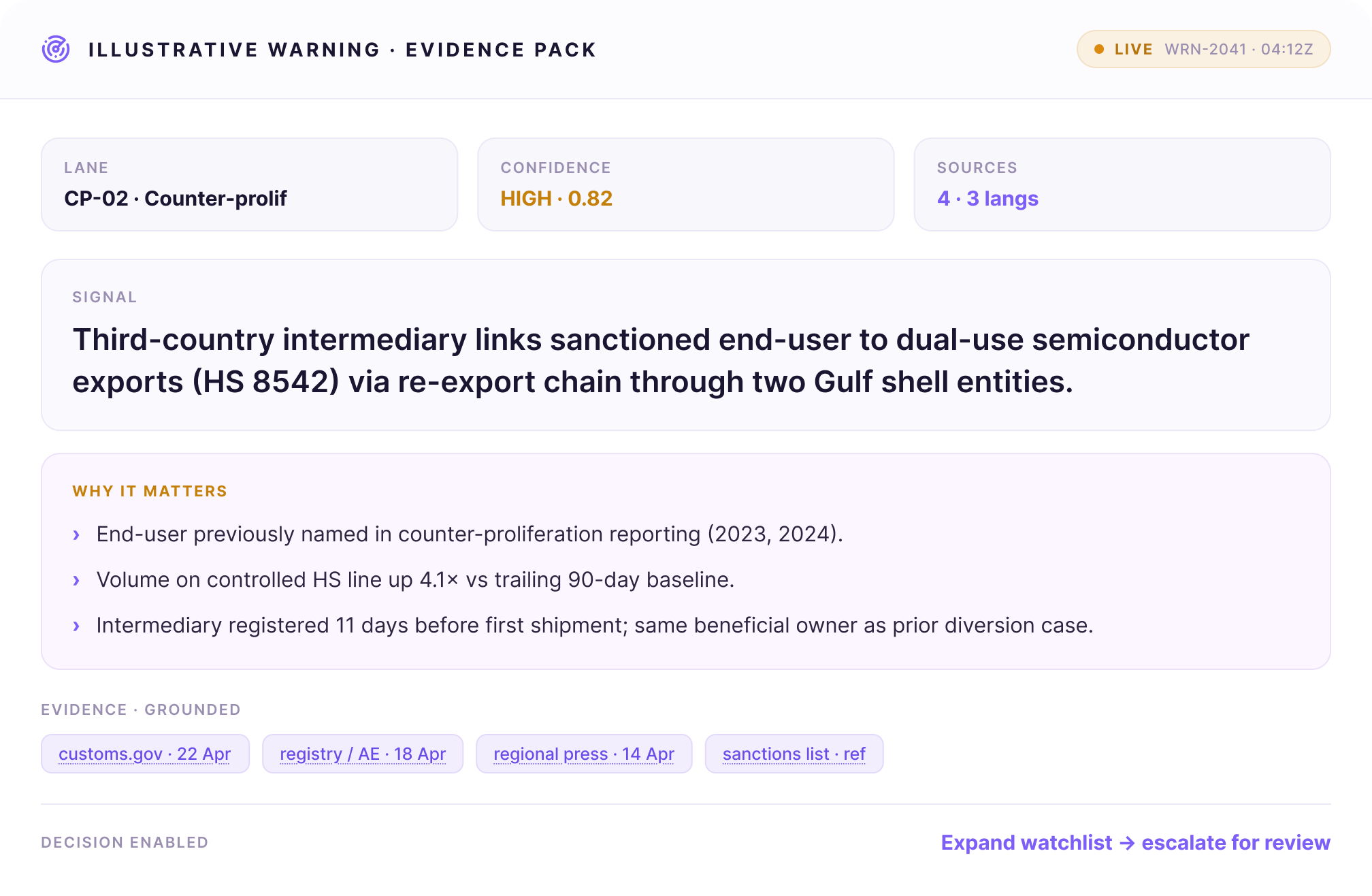
Evidence pack
URL, timestamp, language, source, extracted context, entity, event type and confidence rationale.
→ ESCALATE FOR REVIEW
Report Studio brief
BLUF, what changed, why it matters, confidence, watchlist additions, intelligence gaps, source annex.
→ BRIEF LEADERSHIP
Dashboard · API · batch
Structured delivery into analyst workflows, customer dashboards and internal systems.
→ TASK FURTHER ANALYSIS
Executive INTSUM
Weekly or monthly roll-up for leadership, procurement, risk, security or mission owners.
→ DECISION SUPPORT
Bring one mission question. Receive a source-traceable warning product.
SV scopes a focused proof of value around a defined entity set, commodity, HS-code family, supplier network, route, critical-infrastructure node, diversion pathway or narrative theme.
Entity, supplier, HS code, commodity, route, facility, port, infrastructure node or adversary narrative theme.
What to expect: a 30-minute scoping call → a defined mission seed → a sample watchlist / evidence pack.
Input: one entity, commodity, HS code, route, facility, or narrative theme.
Receive a scoped proof-of-value path with watchlists, evidence packs and briefing-ready outputs.
→ START SCOPING

Request a Defense Capability Briefing.
Bring one mission question. We will map the signals, the risk logic, the evidence requirements, the decision it enables, and walk you through a scoped proof-of-value.

