
AI-Driven Small-Cap Alpha: Media Sentiment Models for US Small Caps
Discover how machine learning on 1.1M+ daily news articles turns global media sentiment into predictive trading signals across a broad universe of US small-cap equities. Backtested by AltHub on its QuantLab platform over a 3-year out-of-sample period (2023–2025), the long-only portfolios revealed a clear pattern: as signal conviction increased, so did alpha – from +10.8% across the full universe to +23.6% (Top 20) and +34.2% (Top 10) versus the S&P 600 Small Cap benchmark. Includes full performance results, ML model design, portfolio construction rules, and transaction-cost-adjusted returns.
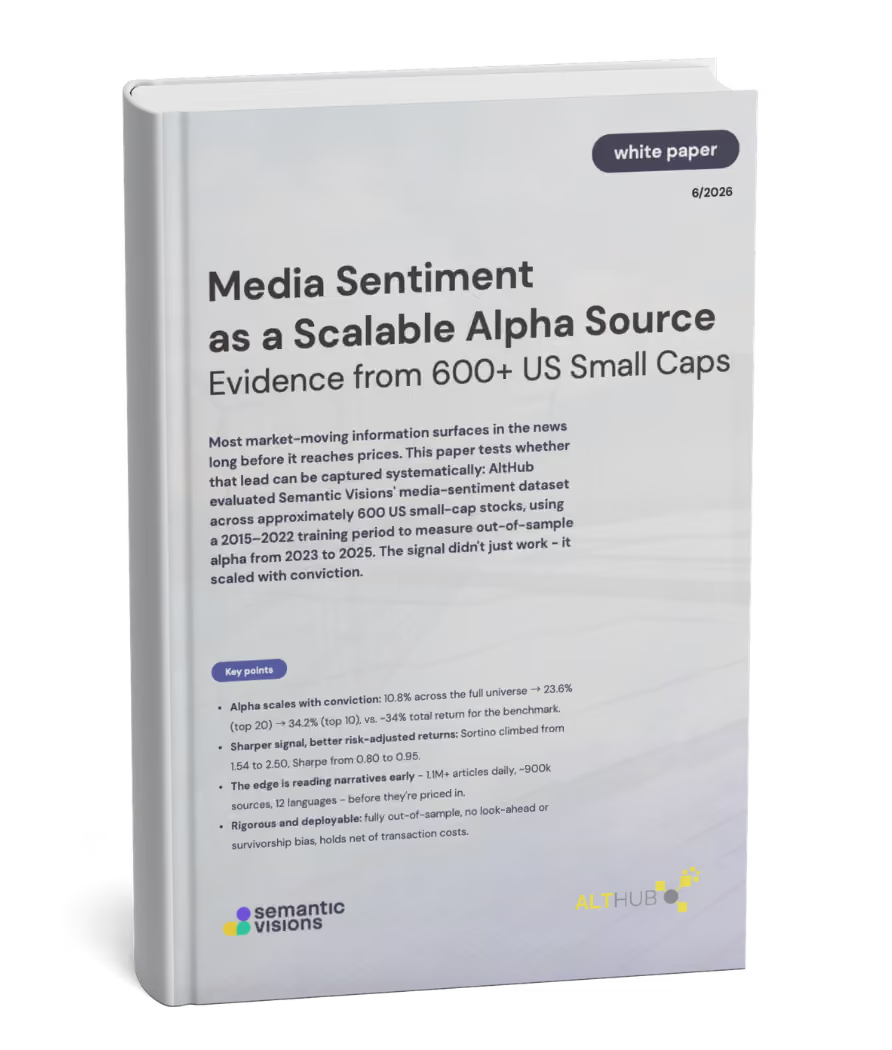
Download Our Whitepaper
From narrative to alpha – before the tape catches up.
Markets don't price information instantly. Earnings narratives, distress signals, regulatory shifts and shifting investor perception all flow through the media before they reach equity prices — and small caps, with thin analyst coverage and low institutional attention, are where that lag is longest. This paper shows how 1.1M+ daily articles across 220,000+ domains and 12 languages were aggregated through a three-tier pipeline — article → scenario → company — into a clean, ticker-mapped daily time series that integrates directly into existing quantitative frameworks.
The signal scales with conviction.
Backtested on AltHub's QuantLab using 7 years of training data (2015–2022) and a rigorous 3-year out-of-sample period (2023–2025), the diversified universe of ~600 stocks delivered a 98.2% total return (10.8% alpha). Concentrating capital into the Top 20 daily signals lifted this to 196.5% (23.6% alpha), and the Top 10 to 307.2% (34.2% alpha) – more than four times the starting capital, versus ~34% for the S&P 600 Small Cap benchmark. Risk-adjusted returns improved in lockstep, with Sortino rising from 1.54 to 2.50.
Small caps are where information moves slowest — and alpha hides longest.
The standout finding is the relationship between conviction and return: the more selective the portfolio, the more alpha it captured. This monotonic improvement is strong evidence that the signal isn't just directional – it ranks opportunities by expected return potential. In the under-covered, information-inefficient small-cap segment, that ranking ability translates directly into excess return, and it held net of transaction costs (Top 10: ~298% at 1bp).
Built to withstand scrutiny.
A fully replicated, point-in-time investment universe eliminates look-ahead and survivorship bias: delisted, acquired, and delisted-for-cause companies were removed at the appropriate time. Combined with the clean train/test split and transaction-cost scenarios at 1, 2, and 3 bps, the result is robust out-of-sample evidence that media-sentiment alpha is both persistent and scalable.
Who it's for:
Quantitative funds, asset managers, portfolio managers, and risk officers building or augmenting equity strategies with alternative data – particularly those seeking scalable, low-correlation alpha in under-researched market segments, and ML-ready, ticker-mapped feature sets that plug directly into existing factor models, risk systems, or standalone signal pipelines.
Explore Real-Time Risk Detection in svEye™
See how dynamic event monitoring works in practice. Track supplier and partner risks across jurisdictions, industries, and ownership networks — all in one dashboard.

Map Your Competiton
or Monitor Your Supply Chain
Contact us to get a customized competitive analysis tailored to your industry and specific business needs or discover other tiers of your supply chain. Let us help you stay ahead in the market.
