
Hidden Signals, Real-Time Resilience: Ground-Level Intelligence for Global Supply Networks
Discover how native-language OSINT across 12 languages surfaces supply chain disruptions before they escalate into global operational crises. Three empirical case studies — the Mantoverde mine strike in Chile, the Port of Leixões customs meltdown in Portugal, and the Darsena Toscana bridge collapse in Italy — show hidden local signals delivering up to 9 days of lead time ahead of global markets and mainstream media. Includes full event timelines, media coverage analysis by language, and a practical framework for operationalizing OSINT across procurement, logistics, and risk workflows.
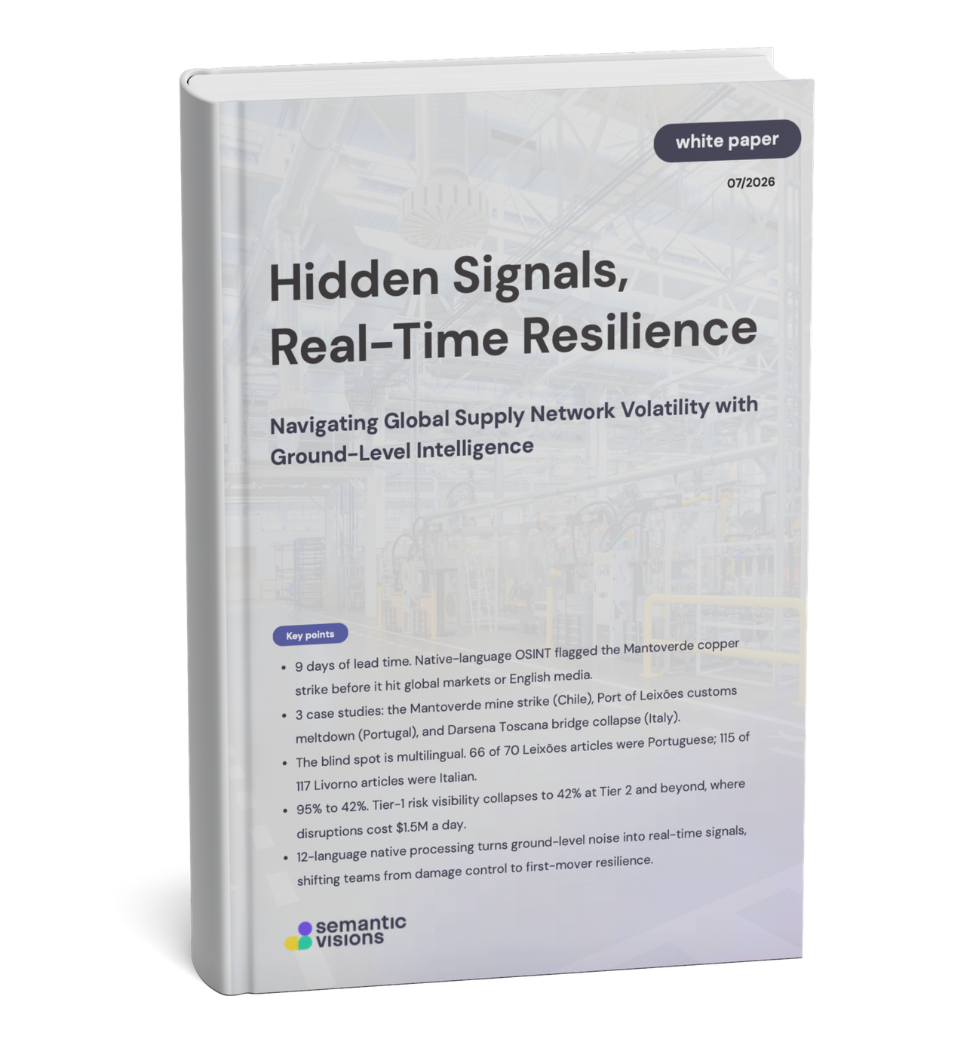
Download our White Paper
About this White Paper
The disruption was public. Just not in English.
By the time a supply chain crisis reaches mainstream international media, it has already shifted from a risk signal to a realized operational loss. The data trail, however, starts much earlier — in hyper-local, native-language reporting. Of 70 articles covering the Leixões port meltdown, 66 were in Portuguese; of 117 articles on the Livorno bridge collapse, 115 were in Italian. To an English-only monitoring system, both events were practically invisible as they unfolded.
A 9-day head start on global markets.
The Mantoverde strike left a distinct open-source trail: local Spanish-language warnings on December 24, a confirmed 96% strike-authorization vote on December 26, mainstream pickup only on January 1–2 — and copper breaking $13,000 per ton on January 5, nine full days after the first open-source warnings. For procurement and trading teams, that window is the difference between locking in pre-crisis rates and paying spot-market premiums.
The blind spot starts at Tier 2 — and outside the gates.
While 95% of supply chain leaders report clear visibility into Tier 1 risks, that insight collapses to 42% at Tier 2 and beyond, where disruptions cost an average of $1.5M per day. The case studies also show that an asset's true vulnerability often lies completely outside its primary facility — a desalination plant 40 kilometers from the mine it supplies, a single mobile bridge controlling terminal access — nodes that never appear on standard risk assessments.
From damage control to first-mover resilience.
The paper details how to operationalize hidden signals as active decision triggers: locking in contract volumes before regional stress hits global indexing, rerouting freight to secondary ports ahead of competitors, adapting production schedules days before tracking systems flag a standstill — while simultaneously fulfilling due diligence obligations under frameworks such as the CSDDD.
Who it's for:
Supply chain, procurement, and logistics leaders; risk and resilience teams; compliance officers navigating CSDDD and LkSG obligations; and manufacturing organizations with multi-tier, multi-region supplier networks — particularly those seeking real-time, entity-mapped early warnings that integrate directly into existing risk frameworks.
Explore Real-Time Risk Detection in svEye™
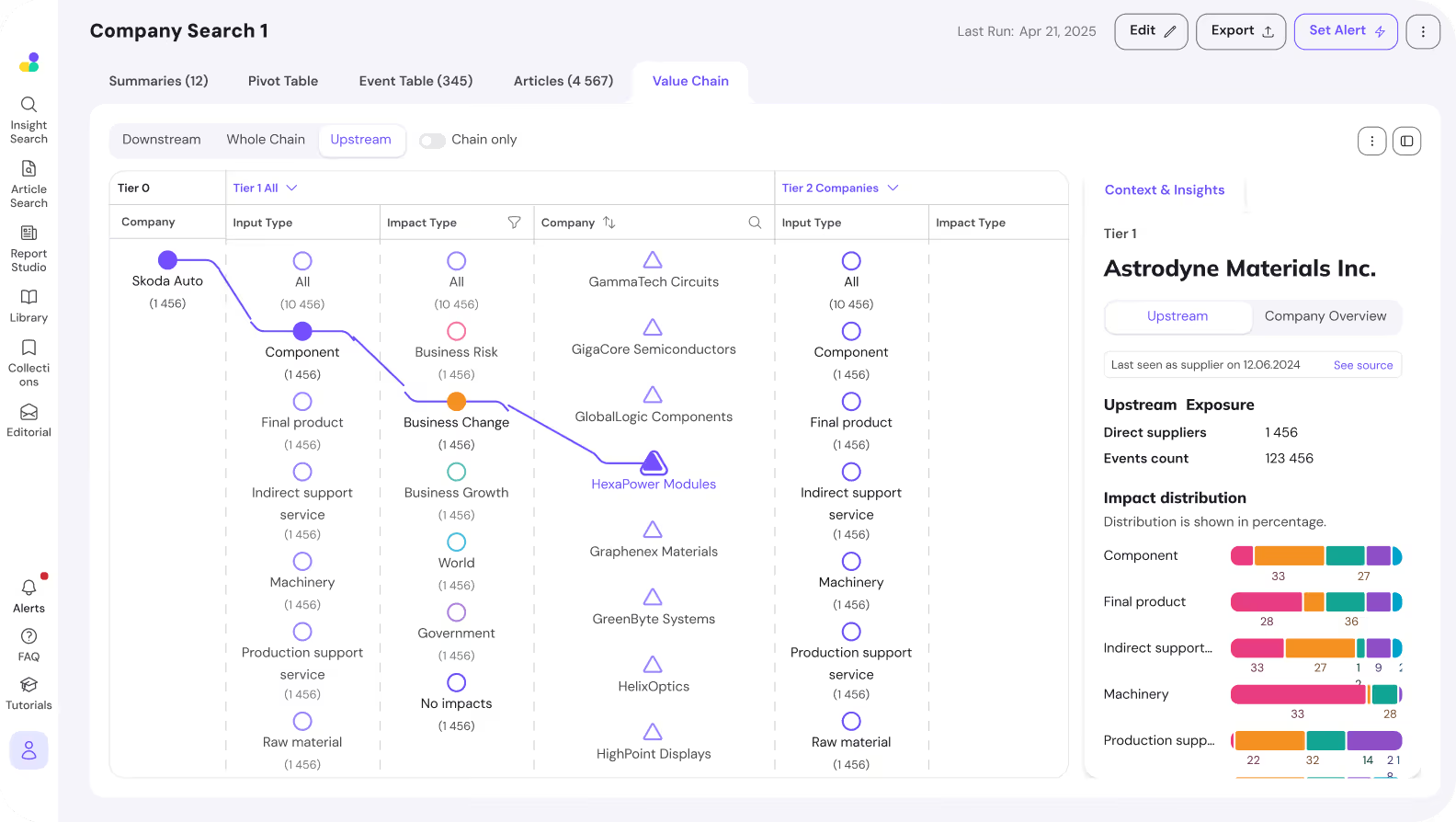
See how dynamic event monitoring works in practice. Track supplier and partner risks across jurisdictions, industries, and ownership networks — all in one dashboard.
Map Your Competiton
or Monitor Your Supply Chain
Contact us to get a customized competitive analysis tailored to your industry and specific business needs or discover other tiers of your supply chain. Let us help you stay ahead in the market.
