

.avif)
The structural problem with questionnaire-driven TPRM
Most third-party risk programs run on the same backbone: an intake questionnaire at onboarding, certification checks (ISO 27001, SOC 2, PCI), a risk tier, and an annual or biennial reassessment. Platforms like OneTrust, Prevalent, ProcessUnity, Black Kite and Aravo are excellent at this part. They centralise vendor inventory, automate workflow, and produce defensible audit trails.
But that approach has two structural weaknesses, and they compound each other:
- The data is self-reported. Vendors describe their own controls, financials, and governance. They have no incentive to surface deterioration between assessments and often no internal visibility into how external parties (regulators, courts, the press, their own suppliers) are characterising them.
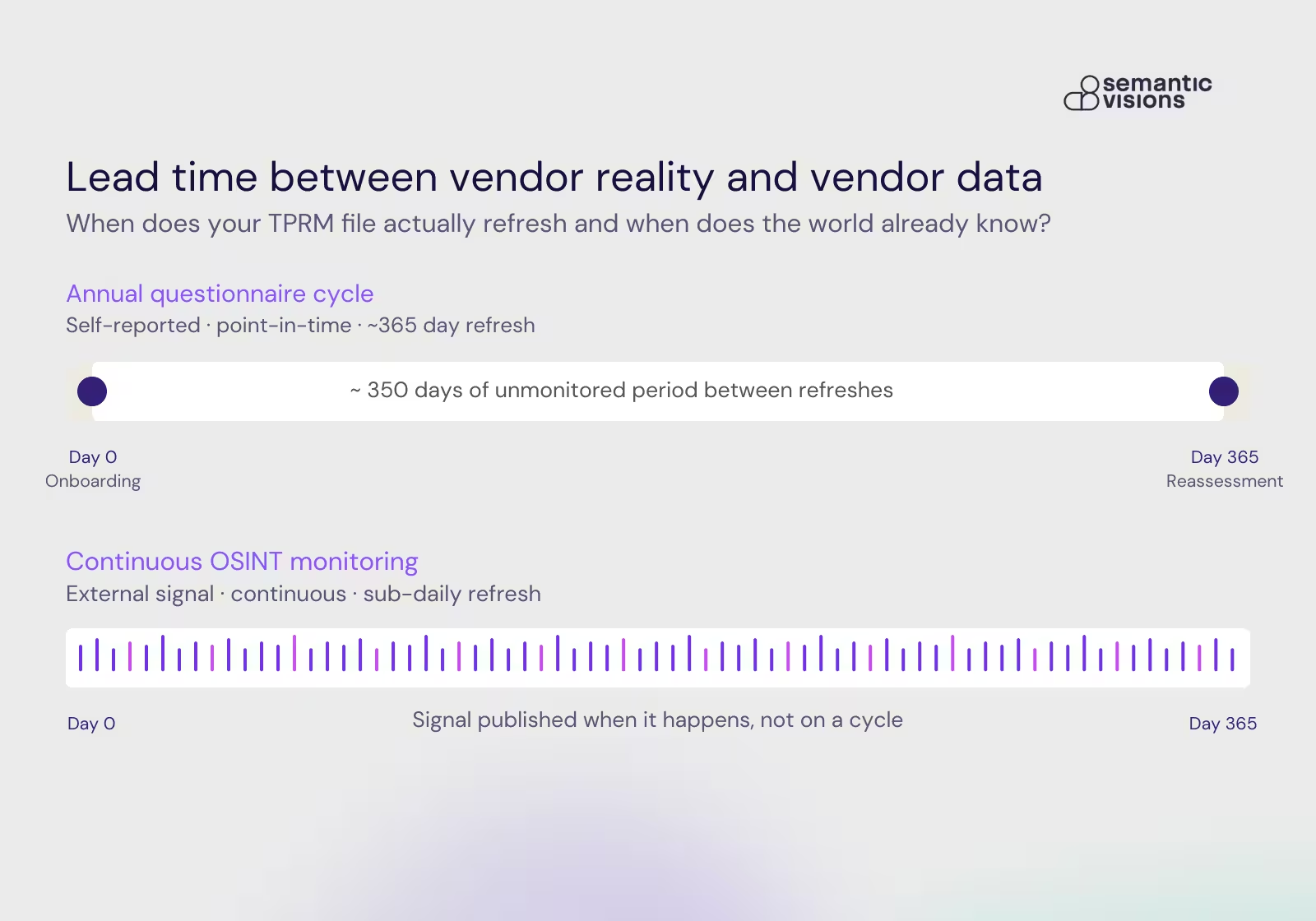
- The data is point-in-time. Even a thorough annual reassessment captures one snapshot every twelve months. A critical vendor can deteriorate, breach, get sanctioned, lose key executives, or enter restructuring talks for ten of those twelve months and your TPRM system will still show "green" until the next questionnaire refreshes the file.
This is not a critique of TPRM platforms. It is a description of what those platforms were built to do: manage the process of third-party risk. What sits outside that process, what the rest of the world publishes about your vendors between cycles has historically been left to manual horizon-scanning by analyst teams, which does not scale past the first fifty vendors.
The blind spot, in numbers
A typical mid-size enterprise has between 500 and 5,000 third parties. Critical vendors are reassessed annually; lower-tier vendors every 18–24 months. That means, on any given day:
- A Tier 1 vendor's last reviewed data is, on average, 6 months old
- A Tier 2 vendor's last reviewed data is, on average, 9–12 months old
- A Tier 3 vendor's last reviewed data is, on average, 18+ months old
The financial press, regulatory filings, court records, supplier announcements, sanctions lists, ESG databases, and the broader news graph do not operate on this cycle. They publish continuously, in 12+ languages, across tens of millions of sources. The lead time between the first public signal of trouble and the eventual inclusion of that trouble in a self-reported vendor questionnaire is regularly measured in months and sometimes in years.
What an external signal layer actually monitors
Continuous third-party risk monitoring with OSINT (Open-Source Intelligence) is not the same as setting up Google Alerts on vendor names. The volume, multilingualism, and ambiguity of the global news graph defeats keyword-based monitoring within the first dozen vendors. A working OSINT layer does three things keyword alerts cannot:
- Entity resolution at corporate-structure depth: disambiguating "Acme Logistics GmbH" from its parent, subsidiaries, named JVs and supply-chain dependents.
- Event extraction across language and source type: recognising that a Portuguese-language court filing, an English-language analyst note, and a Mandarin trade-press article are reporting the same underlying event.
- Signal classification and severity weighting: distinguishing a CFO departure (signal) from a CFO LinkedIn post (noise).
Once those three are in place, the question becomes: which signals matter?
The twelve signals every TPRM program should monitor between cycles
There is no canonical list. The right framework depends on the vendor's role, jurisdiction, and the controls already in your contract. But across hundreds of real-world distress, fraud, and disruption cases, twelve external signals recur consistently enough to form a defensible baseline. They cluster into four categories:
Financial distress signals
1. Credit rating actions and watch-list placement
2. Distressed-financing press (covenant breach, restructuring advisors retained, bridge facilities)
3. Payment-delay mentions surfacing in the vendor's own supplier and customer networks
Operational disruption signals
4. Facility incidents (fire, accident, force majeure)
5. Senior executive departures (CFO, CEO, board chair)
6. Labour actions (strikes, mass layoffs, union disputes)
7. Cybersecurity incidents (breach disclosures, ransomware claims)
8. Quality & recalls
Regulatory and sanctions signals
9. Regulatory investigations and enforcement actions
10. Sanctions list additions affecting the vendor or its beneficial owners
12. Material litigation and adverse judgments
Reputation and ESG signals
12. Sustained negative media-sentiment shifts
13. ESG controversies (human-rights, environmental, governance)
The full version of this framework, with detection-source notes, escalation criteria for each tier, and a one-page integration playbook for OneTrust, Prevalent, Black Kite and ProcessUnity workflows, is in the OSINT Vendor Review Checklist, which you can download free below.

Three real cases, three different lead times
The framework is only useful if the signals actually appear before the failure. Three documented cases:
Fisker, Inc., ~13 months of lead time. Public signal density (production delays, executive turnover, financing-distress press, sentiment deterioration) began accelerating roughly thirteen months before the company's June 2024 Chapter 11 filing. Customers and OEM partners relying on annual reassessment cycles had no opportunity to act on this signal through their TPRM workflow alone.
Novelis / Porsche fire incident, 22 days of lead time. External signal in the Novelis facility ecosystem preceded the supply-chain impact on Porsche's aluminium-dependent production lines by 22 days. The disruption itself was public; the connection back to a downstream OEM was a multi-tier supply chain visibility problem that OSINT can resolve in near-real time.
H&M / Bangladesh apparel disruption. 6 days of lead time. Labour-action signal preceded the production impact by under a week. The relevant signal was not in a self-reported supplier questionnaire; it was in local-language press, NGO reports, and worker-rights filings.
In each of these, the signal was public. What was missing was the layer that ingests, classifies, and routes it to the people inside the customer organisation who could act on it.
How OSINT complements (rather than replaces) your TPRM platform
A continuous OSINT layer is not a TPRM platform substitute. The two answer different questions:
- Your TPRM platform answers "what controls and assertions has this vendor formally provided, and are we tracking the cycle properly?" the perimeter and the workflow.
- An OSINT layer answers "what is the external world saying about this vendor right now, and which of those signals exceeds an escalation threshold?" the continuous watch.
In practice, this means the OSINT layer feeds escalation triggers back into the existing TPRM workflow. A sanctions-list signal automatically triggers a contract-review task in OneTrust. A facility-incident signal opens a business-continuity review in Prevalent. A sustained sentiment shift triggers an ad-hoc reassessment in ProcessUnity. The platforms remain the system of record. The OSINT layer becomes the system of alert.
This is what svChain is built to do for organisations whose vendor portfolios exceed the scale at which manual horizon-scanning works typically anywhere from 100 third parties upwards. The platform monitors tens of millions of companies across hundreds of thousands of sources in 120+ languages, classifies events against the twelve-signal framework, and integrates the resulting escalation triggers into the TPRM workflow you already operate.
What to do next
If you take one thing from this article, take this: the question is not "do we have a TPRM platform?" by the size of the customer base of OneTrust alone, the answer for most enterprises is yes. The question is "between our scheduled assessments, what would have to be true for us to know that a critical vendor is in distress before the disruption hits our operations?"
That answer is almost never another questionnaire. It is an external signal layer running in parallel.
Download the free checklist. The 12-signal OSINT vendor review framework, with detection-source notes, escalation criteria, and integration steps for existing TPRM workflows, packaged as a one-document checklist you can hand to your vendor risk team.
See it running. If you'd like to see continuous OSINT-based vendor monitoring against a real portfolio, your own, or a benchmark set, request a svChain demo.
Semantic Visions monitors tens of millions of companies across hundreds of thousands of sources in 12+ languages to surface third-party, supply-chain and reputational risk before it appears in self-reported channels. See risk before it's news.
Access Premium Insights
.png)

.avif)
See Everything. Focus on What Matters.
svEye™ filters the noise to uncover meaningful patterns and insights. Gain clarity, stay informed, and drive smarter decisions with a comprehensive overview.

